
Official-source review: August 24, 2026
A Texas fire alarm technician license is required for an individual who sells, installs, certifies, services or monitors regulated fire alarm and detection systems in Texas. The credential is called the Fire Alarm Technician license, commonly abbreviated as FAL, and is issued by the Texas Department of Insurance State Fire Marshal’s Office.
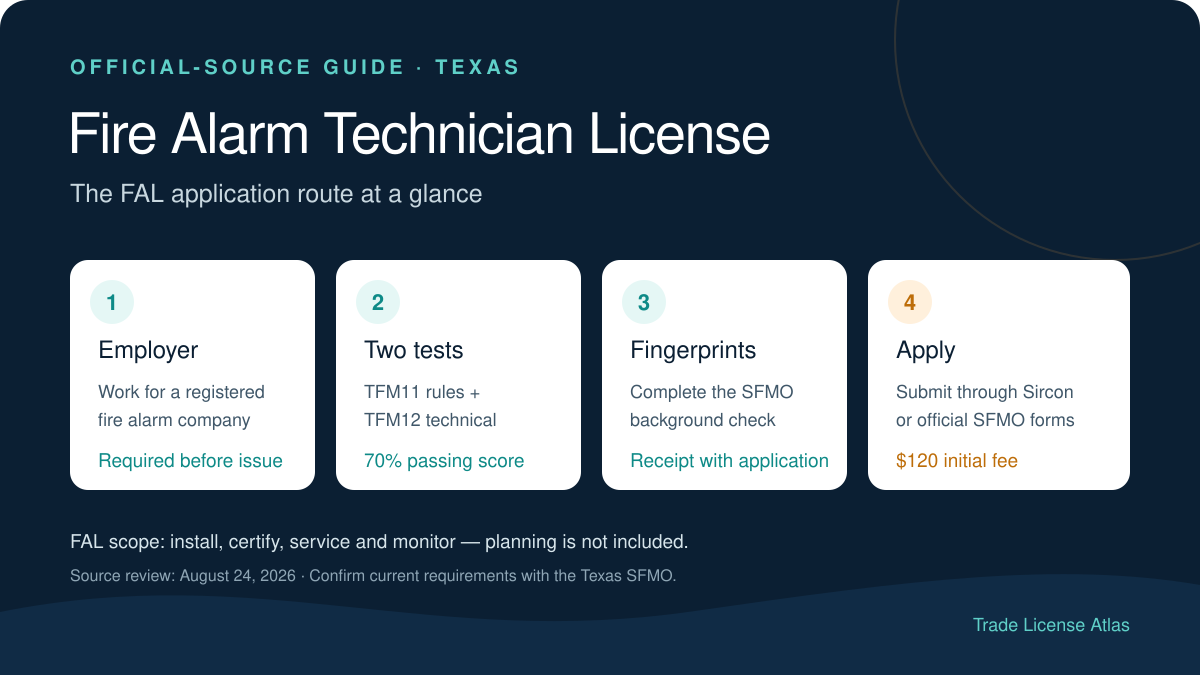
Texas fire alarm technician license requirements at a glance
| Requirement | What the official guide requires |
|---|---|
| License | Fire Alarm Technician (FAL), issued to an individual |
| Employer | Employment by a company holding an Alarm Certificate of Registration |
| Tests | TFM11 Fire Alarm Statutes and Rules plus TFM12 Fire Alarm Technician |
| Passing score | At least 70% on each required test |
| Background check | Fingerprint receipt submitted with the application unless SFMO already has fingerprints on file |
| State license fee | $120 initial FAL fee; testing and fingerprint provider charges are separate |
| Planning authority | Not included; system planning requires an appropriate superintendent or other authorized professional |
The Texas fire alarm technician license differs from a general Texas electrician license. Electrician licensing is administered by TDLR, while fire alarm individual licenses and company registrations are administered by the Texas Department of Insurance through the State Fire Marshal’s Office. A worker or business may need credentials from more than one program depending on the actual work performed.
What work can a Fire Alarm Technician perform?
According to the SFMO licensing guide, an individual holding an FAL may sell, install, certify, service and monitor all types of fire alarm or detection devices and systems. For this program, servicing includes activities such as inspecting, maintaining, repairing and testing.
The key limitation is planning. An FAL does not authorize the license holder to plan a fire alarm system. Planning authority is associated with credentials such as the Fire Alarm Planning Superintendent license. A Residential Fire Alarm Superintendent has a different scope focused on one- and two-family dwellings but may also perform the functions permitted to an FAL.
Individual license versus company registration
Texas issues a license to the individual technician and a registration to the business. These two approvals depend on each other. SFMO states that it cannot issue an individual fire alarm license until the person is employed by a registered company. It also cannot register a new company without an appropriately licensed designated employee.
The Texas fire alarm technician license belongs to the individual; it does not replace the employer’s Alarm Certificate of Registration.
A company that plans, certifies, leases, sells, services, installs, monitors or maintains fire alarm or detection systems generally needs an Alarm Certificate of Registration, known as an ACR. The designated full-time employee for a standard ACR must hold an FAL, Fire Alarm Planning Superintendent license or Residential Fire Alarm Superintendent license. A Residential Fire Alarm Technician license alone is not sufficient to qualify a company for the standard ACR.
How to get a Texas fire alarm technician license
- Confirm that FAL is the correct credential. Use the permitted-work table in the official SFMO guide to distinguish technical, planning, monitoring and residential scopes.
- Arrange employment with a registered company. The individual application must identify the company where the technician will be registered.
- Prepare for TFM11. This test covers Texas Insurance Code Chapter 6002 and the Texas Administrative Code fire alarm rules.
- Prepare for TFM12 or document a qualifying alternative. The technical test covers adopted NFPA standards and practical electrical and fire-alarm knowledge. Qualifying NICET or ESA credentials may replace the technical test but not the statutes-and-rules test.
- Pass every required test. SFMO requires a score of at least 70%. PSI sends official scores to the agency.
- Complete the fingerprint process. Request the service code, attend the approved fingerprint appointment and keep the receipt.
- Submit the application. Apply through the online Sircon route when available or use the current individual application published by SFMO.
- Pay the state fee and include supporting documents. The initial FAL fee is $120; testing and fingerprint costs are paid separately to their providers.
If you need a different occupation or state, use the license finder or browse the directories for trades and U.S. licensing jurisdictions.
Texas fire alarm technician exams
TFM11 Fire Alarm Statutes and Rules
Every FAL applicant must pass the Fire Alarm Statutes and Rules test. Its study material is Texas Insurance Code Chapter 6002 and the fire alarm rules in the Texas Administrative Code. A national technical certification does not replace this Texas-specific legal test.
TFM12 Fire Alarm Technician
The technical examination addresses the adopted fire-alarm standards and practical system knowledge. The official outline identifies NFPA 72, relevant National Electrical Code articles and standards relating to sprinkler, extinguishing, inspection and ventilation systems. Topics include equipment and circuits, wiring, detector operation and placement, notification circuits, supervisory circuits and testing requirements.
SFMO states that its tests are closed book, contain 50 true-or-false or multiple-choice questions and require a minimum score of 70%. An applicant may schedule each type of test only once per week and no more than three times in a twelve-month period.
NICET and ESA alternatives
The TFM12 technical requirement may be replaced by passing the NICET Level II Fire Alarm Systems testing requirement or holding a current ESA Level II Fire Alarm Technician certification. The applicant must provide the documentation specified by SFMO. This alternative does not waive TFM11. The official guide also describes a technical-test waiver for a Texas-licensed professional engineer, but the statutes-and-rules test remains required.
Texas fire alarm technician license cost
| Credential or transaction | Initial fee | Two-year renewal fee |
|---|---|---|
| Fire Alarm Technician (FAL) | $120 | $200 |
| Fire Alarm Planning Superintendent | $120 | $200 |
| Fire Alarm Monitoring Technician | $120 | $200 |
| Residential Alarm Technician | $50 | $100 |
| Main-office Alarm Certificate of Registration | $500 | $1,000 |
| Branch-office registration | $150 | $300 |
The minimum Texas fire alarm technician license budget is not limited to the $120 state fee. PSI examination charges, fingerprinting, study references and any NICET or ESA costs are separate. Fees are generally nonrefundable, and late renewal charges can apply. Check the official guide and provider checkout page immediately before paying.
Fingerprint and background-check process
Applicants who do not already have fingerprints on file with SFMO must complete the agency’s fingerprint process. The current instructions begin with a formal intent request used to obtain the correct fingerprint service code. The applicant then schedules with IdentoGO, presents acceptable photo identification and pays the provider charge.
The fingerprints are transmitted to the Texas Department of Public Safety and the FBI for criminal-history checks. IdentoGO provides a receipt; a copy must accompany the license application, while the applicant keeps the original. Sending fingerprint cards directly to SFMO can delay the process.
Company registration and insurance
A technician’s employer must hold the appropriate company registration. For a standard ACR, the company submits its application, identifies a qualifying designated full-time employee and files a certificate of liability insurance. New individual and company applications should be submitted together when both are being created.
The current SFMO insurance guidance requires a registered company to maintain general liability coverage of at least $100,000 combined single limit per occurrence and $300,000 total for the policy year. The policy must include products and completed operations coverage. The certificate must correctly name the registered business, describe the covered fire-alarm activity and list SFMO as certificate holder.
These insurance limits apply to the registered company rather than being a personal insurance requirement for the individual FAL holder. A company with an expired insurance certificate can fall out of compliance, and SFMO states that it will not approve new applications or renewals until the insurance requirement is satisfied.
Renewing a Texas Fire Alarm Technician license
TDI lists a $200 fee for a two-year FAL renewal and directs licensees to use Sircon for online renewal. The agency sends a renewal notice before expiration, but the license holder remains responsible for keeping contact details current and renewing on time.
The current summary guide does not list a general continuing-education requirement for an FAL renewal. That should not be treated as a permanent exemption: renewal conditions and adopted technical standards can change, so confirm the current requirements through the official licensing page before renewal.
If a technician changes or adds an employer, SFMO directs the licensee to use the application to revise or transfer a fire alarm license. The guide lists a $20 fee for a duplicate license or an employer revision.
Application checklist
- Confirm that the FAL scope covers all intended work and that no planning credential is required.
- Identify the registered fire alarm company that will employ and register you.
- Pass TFM11 and TFM12, or document the accepted technical-test alternative.
- Verify that each required score is at least 70%.
- Complete the SFMO fingerprint-intent process and approved fingerprint appointment.
- Attach or upload the fingerprint receipt as instructed.
- Use the current Sircon application or official SFMO form.
- Pay the $120 initial state license fee and budget separately for provider charges.
- Keep copies of the application, scores, fingerprint receipt and payment confirmation.
Frequently asked questions
Can a Texas Fire Alarm Technician design a fire alarm system?
No. The official FAL scope allows selling, installing, certifying, servicing and monitoring, but it does not include planning. Planning requires an appropriate superintendent credential or another authorized professional route.
Do I need experience hours for a Texas FAL?
The current SFMO summary does not state a minimum number of work-experience hours for the Fire Alarm Technician route. It requires the tests, fingerprints, application, fee and employment by a registered company.
Can I apply without a fire alarm company employer?
SFMO states that it cannot issue an individual license until the applicant is employed by a registered company. The application must identify the company where the technician will be registered.
Does NICET Level II replace both Texas tests?
No. Qualifying NICET Level II testing can replace the TFM12 technical requirement, but the Texas-specific TFM11 Fire Alarm Statutes and Rules test is still required.
Is the Texas fire alarm technician test open book?
No. The SFMO guide says its tests are closed book. Each test contains 50 true-or-false or multiple-choice questions and requires a score of at least 70%.
How much does the Texas fire alarm technician license cost?
The initial FAL state fee is $120. The total will be higher after separate testing, fingerprinting, study-material and optional certification costs.
Can an FAL qualify a company for an Alarm Certificate of Registration?
Yes. A standard ACR may designate a full-time employee who holds an FAL, Fire Alarm Planning Superintendent license or Residential Fire Alarm Superintendent license. The exact business scope still depends on the licenses held by its employees.
Official sources used
- Texas SFMO fire alarm registration, license and test guide
- Texas fire alarm licensing portal and online application information
- SFMO fingerprint requirements and instructions
- SFMO certificate of liability insurance requirements
- Official fire alarm company forms
- Texas Insurance Code Chapter 6002
Verified licensing details
- Jurisdiction
- Statewide license
- Licensing authority
- Texas Department of Insurance, State Fire Marshal’s Office (SFMO)
- Fees
- Fire Alarm Technician (FAL): $120 initial license fee and $200 two-year renewal fee. Provider charges for PSI testing and fingerprints are additional. A main-office Alarm Certificate of Registration costs $500 initially.
- Experience
- The current SFMO licensing guide does not state a minimum number of experience hours for the FAL route. The applicant must pass the required tests, complete the fingerprint process, and be employed by a registered fire alarm company before the individual license can be issued.
- Exams
- Pass the Fire Alarm Statutes and Rules TFM11 test and the Fire Alarm Technician TFM12 test with at least 70%. The TFM12 requirement may be replaced by qualifying NICET Level II testing or current ESA Level II Fire Alarm Technician certification; TFM11 is still required.
- Insurance or bond
- Insurance applies to the registered company rather than the individual FAL. The company must file proof of general liability insurance showing at least $100,000 per occurrence and $300,000 total for the policy year, including products and completed operations coverage.
- Continuing education
- The current SFMO fire alarm licensing guide does not list a general continuing-education requirement for renewing an FAL. Licensees should verify current renewal conditions before the expiration date.
- Renewal period
- TDI lists a $200 fee for a two-year FAL renewal and sends a renewal notice before expiration. Renewals are handled through Sircon.
Official sources
Official sources last checked August 23, 2026.
Requirements can change and local rules may apply. Confirm the current requirements with the official authority before paying a fee or beginning work.