
Official-source review: August 24, 2026
A Texas HVAC contractor license is required to offer or perform non-exempt air-conditioning and refrigeration contracting for the public. Texas calls the credential an Air Conditioning and Refrigeration Contractor license, and the Texas Department of Licensing and Regulation issues it to qualified individuals.
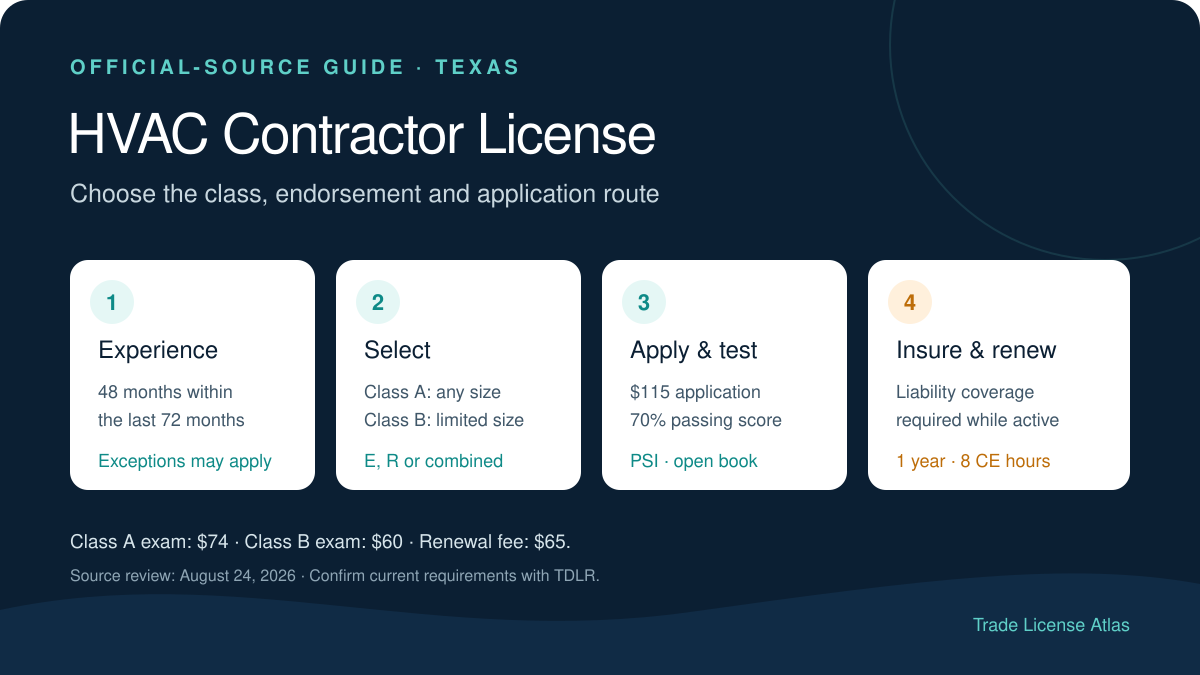
Texas HVAC contractor license requirements at a glance
| Requirement | Current TDLR route |
|---|---|
| Minimum age | 18 |
| Standard experience | 48 months under a licensed ACR contractor during the previous 72 months |
| Certified-technician route | Certified for the preceding 12 months plus 36 months of experience during the previous 48 months |
| Application fee | $115 |
| License selection | Class A or B, plus Environmental Air, Commercial Refrigeration or the applicable combined endorsement |
| Exam | PSI examination matching the selected class and endorsement; 70% passing score |
| Insurance | Commercial general liability with minimums determined by license class |
| License term | One year |
| Renewal | $65 and 8 approved CE hours, including 1 hour of Texas law and rules |
This guide covers the contractor credential used to contract directly with customers. A registered or certified technician has a different role and performs covered work under a licensed contractor. Use the license finder when comparing occupational routes.
Who needs a Texas HVAC contractor license?
TDLR states that contractors who install, repair or maintain regulated air-conditioning, refrigeration or heating systems must hold the state license. An ACR company must employ an appropriately licensed contractor at each permanent business location.
The contractor license is the route for a person who will offer HVACR contracting services to the public, obtain work through a business affiliation and take responsibility for regulated projects. Employees performing covered work generally need the applicable technician registration or certification and must work under a licensed contractor.
Do not assume that a small system is automatically exempt. TDLR specifically explains that a mini-split is a split system rather than a self-contained portable unit, so contracting work on a mini-split requires the appropriate contractor license. Local building permits may still apply even though municipalities may not charge a separate registration fee to a TDLR-licensed ACR contractor.
Class A vs. Class B HVAC licenses
The class on a Texas HVAC contractor license controls the maximum system capacity that the contractor may work on:
| License class | Permitted system size | Exam fee | Liability minimums |
|---|---|---|---|
| Class A | Any size unit | $74 | $300,000 per occurrence; $600,000 aggregate; $300,000 products/completed operations |
| Class B | Cooling systems of 25 tons or less and heating systems of 1.5 million BTU/hour or less | $60 | $100,000 per occurrence; $200,000 aggregate; $100,000 products/completed operations |
A Class B license can cover many residential and light-commercial projects, but its capacity limits are legal scope restrictions rather than recommendations. Choose Class A when intended work may exceed either Class B threshold. A contractor who later upgrades from Class B to Class A must request the change, pay the applicable fee, pass the new examination and increase insurance coverage.
Environmental Air and Commercial Refrigeration endorsements
Class alone does not define the entire Texas HVAC contractor license. The applicant must also choose the endorsement that matches the work:
- Environmental Air Conditioning (E): treating air to control temperature, humidity, cleanliness, ventilation and circulation for human comfort. It includes central air conditioning and heating.
- Commercial Refrigeration and Process Cooling or Heating (R): temperature or humidity control for the intended use of a space, production process or equipment. TDLR describes this endorsement as limited to coolers, freezers, ice machines and related temperature- and humidity-control equipment.
- Combined (C): combines the Environmental Air and Commercial Refrigeration/Process Cooling or Heating scopes.
Each license number carries one class and one endorsement. A person applying for more than one class receives the applicable license numbers on a single document, but the business affiliation and addresses must be the same.
Experience requirements and permitted exceptions
Standard 48-month route
The standard Texas HVAC contractor license route requires at least 48 months of practical air-conditioning and refrigeration work under the supervision of a licensed ACR contractor. Those months must fall within the 72 months immediately preceding the application.
The supervisor completes the official Experience Verification Form. Applicants must not complete that verification for themselves. Multiple supervisors may complete separate forms when the qualifying period spans different employers.
Certified-technician route
An applicant who has held a Texas technician certification for the preceding 12 months may qualify with at least 36 months of supervised practical experience during the previous 48 months. A technician registration and a technician certification are not interchangeable for this reduced-experience route.
Education substitutions
TDLR publishes several education-based exceptions for a Texas HVAC contractor license:
- A relevant four-year degree can replace 24 months of practical experience.
- A relevant two-year associate degree, diploma or certification program can replace 12 months.
- A one-year program, or one lasting at least two semesters, can replace 6 months.
- Every 2,000 hours of on-the-job training in an apprenticeship program is treated as 12 months of practical experience.
Degrees from outside the United States and other related programs are evaluated individually. The applicant should submit transcripts, diplomas or certificates with enough detail for TDLR to identify the program and award.
Other qualifying experience
TDLR may accept qualifying work for regulated utilities, governmental entities, industrial operations and certain licensed engineers. Verified military HVACR training and duties lasting at least 24 months may satisfy the full 48-month requirement. These are evidence-based exceptions, not automatic waivers; the application should include the documents specified by TDLR.
How to get a Texas HVAC contractor license
- Choose the correct scope. Decide whether Class A or B and the E, R or combined endorsement covers all intended work.
- Document qualifying experience. Have each supervisor complete the official verification form and gather any education, apprenticeship, governmental or military evidence.
- Complete the contractor application. Identify the license class, endorsement and business affiliation accurately.
- Pay the $115 application fee. The application must be completed within one year, including the examination.
- Wait for examination eligibility. TDLR reviews the qualifications before PSI sends scheduling instructions.
- Prepare the approved references. Download the current candidate bulletin and use only the permitted editions and binding formats.
- Pass the matching PSI examination. Class A and B examinations have different lengths and fees.
- Obtain liability insurance. After passing, submit a certificate showing the license holder and business name with coverage meeting the selected class minimums.
- Confirm license issuance. Do not advertise or contract outside the approved class, endorsement or business affiliation.
Other Texas occupational routes include the Texas electrician license, Texas Fire Alarm Technician license and Texas BPAT license. You can also browse the complete trade directory or state directory.
Texas HVAC contractor license exam
The examination depends on both class and endorsement. TDLR lists Environmental Air A, Environmental Air B, Commercial Refrigeration A and Commercial Refrigeration B contractor examinations. Applicants submit their state application first and schedule with PSI only after TDLR approves eligibility.
| Exam route | Scored items | Scored time | Passing score | Fee |
|---|---|---|---|---|
| Environmental Air — Class A | 120 | 230 minutes | 70% | $74 |
| Environmental Air — Class B | 100 | 170 minutes | 70% | $60 |
| Commercial Refrigeration — Class A | 120 | 230 minutes | 70% | $74 |
| Commercial Refrigeration — Class B | 100 | 170 minutes | 70% | $60 |
The current PSI bulletin also lists five non-scored items and ten additional minutes for each contractor examination. The examinations are open book, but reference materials must comply with strict rules. Approved books may be highlighted, underlined, annotated before the session and fitted with permanent tabs. Loose paper, temporary tabs and marking materials during the test are prohibited.
PSI’s bulletin updated July 9, 2026 announces that examinations will reference the 2024 International Fuel Gas Code, International Mechanical Code and Uniform Mechanical Code beginning September 1, 2026. Candidates testing around that transition should download the bulletin again before purchasing books or attending the exam.
Texas HVAC contractor license cost
| Expense | Published amount |
|---|---|
| TDLR contractor application | $115 |
| PSI Class A examination | $74 per attempt |
| PSI Class B examination | $60 per attempt |
| Annual contractor renewal | $65 |
| Add endorsement or upgrade class | $25 change fee plus the applicable examination fee |
The minimum published Texas HVAC contractor license cost is therefore $189 for a Class A route or $175 for Class B before insurance, approved references, preparation courses, education records and any retest. Liability premiums vary by company, coverage and risk, so they should not be represented as a fixed licensing fee.
Liability insurance requirements
A licensed contractor must maintain commercial general liability insurance whenever the Texas HVAC contractor license is active and used to contract with the public. The insurer must be authorized to sell liability coverage in Texas.
Class A requires at least $300,000 per occurrence for property damage and bodily injury, $600,000 aggregate for those claims, and $300,000 aggregate for products and completed operations. Class B requires at least $100,000 per occurrence, $200,000 aggregate, and $100,000 products/completed operations.
A person holding both classes may use one policy if it satisfies the Class A minimums. TDLR also describes a possible insurance waiver for a licensee who does not provide services to the public or works under another contractor, but a person with that waiver cannot offer contracting services to the general public under the waived license.
EPA Section 608 certification
The state contractor license and federal refrigerant certification solve different legal requirements. EPA requires Section 608 certification for technicians who maintain, service, repair or dispose of equipment in a way that could release regulated refrigerants. Connecting gauges, adding or removing refrigerant, opening the refrigerant circuit and many mini-split installations can trigger that federal requirement.
Holding EPA Section 608 certification does not replace the Texas contractor license, and the Texas license does not by itself replace Section 608 certification. A business should verify both the state contracting authority and the certification held by the individual performing refrigerant work.
Renewal and continuing education
The license term is one year. TDLR recommends starting renewal approximately 30–60 days before expiration and lists a $65 renewal fee. A contractor may not perform or offer regulated contracting after the license expires.
Each annual renewal requires 8 hours of approved continuing education completed before expiration. At least 1 of those 8 hours must cover Texas laws and rules regulating licensees. Only TDLR-approved courses count.
Late renewal fees increase with the length of expiration. A license expired 90 days or less generally requires 1.5 times the normal renewal fee. More than 90 days but less than 18 months generally requires twice the normal fee; an 18-month-to-three-year renewal requires executive-director approval and twice the fee. Verify the current procedure before relying on a late-renewal path.
Reciprocity and out-of-state licenses
Texas currently publishes formal HVACR reciprocity agreements with Georgia and South Carolina. The outside license must have been held for at least one year.
A current Georgia Class II Conditioned Air unrestricted license in good standing qualifies for the Texas Class A Environmental Air Conditioning license. No other Georgia credential is listed as reciprocal.
South Carolina equivalencies depend on the credential. TDLR maps the Air Conditioning and Heating license to Texas Class A Environmental Air Conditioning and Commercial Refrigeration; other South Carolina air-conditioning, packaged-equipment and mechanical-refrigeration licenses map to specified Class A or B endorsements. A South Carolina heating-only license does not qualify.
Applicants licensed elsewhere can submit their current license and the requirements used to obtain it. TDLR determines whether the experience and qualifications are substantially equivalent and may still require some or all Texas requirements, including an exam. Use our reciprocity finder as an orientation tool, but rely on TDLR’s written determination.
Application checklist
- Confirm that you are at least 18 years old.
- Select Class A or B based on the largest equipment you expect to service.
- Select Environmental Air, Commercial Refrigeration or the combined endorsement.
- Have every supervisor complete an Experience Verification Form.
- Collect transcripts, apprenticeship records, government-employment evidence or military documents if claiming an exception.
- Submit the current TDLR application and $115 fee.
- Wait for TDLR eligibility before scheduling PSI.
- Download the current candidate bulletin and prepare only permitted references.
- Pass the examination matching the selected class and endorsement.
- Submit a compliant certificate of commercial general liability insurance.
- Keep copies of the application, verification forms, score report, insurance certificate and payment confirmations.
Frequently asked questions
How many years of experience do I need for a Texas HVAC contractor license?
The standard route requires 48 months within the previous 72 months. A person certified as a technician for the preceding 12 months may use the alternative 36-month route, and approved education or experience exceptions can change the calculation.
What is the difference between Texas HVAC Class A and Class B?
Class A covers units of any size. Class B is limited to cooling systems of 25 tons or less and heating systems of 1.5 million BTU per hour or less.
Is the Texas HVAC exam open book?
Yes. The PSI bulletin identifies the contractor exams as open book, but only approved references and binding formats are permitted. Candidates cannot use temporary tabs or loose papers and cannot mark books during the examination.
Can an HVAC technician work without a contractor license?
A properly registered or certified technician can perform covered work as an employee under a licensed contractor. The technician credential does not authorize independent contracting with the public.
Does an HVAC school replace all four years of experience?
Not under the ordinary education substitutions. A relevant four-year degree can replace 24 months, a two-year program can replace 12 months and a qualifying one-year program can replace 6 months. Other specific exceptions may apply based on verified work or military experience.
Does Texas require HVAC contractor insurance?
Yes. A contractor offering services to the public must maintain commercial general liability insurance. The minimum limits depend on whether the license is Class A or B.
Does EPA Section 608 replace the Texas license?
No. Section 608 addresses refrigerant-handling activity under federal rules. The TDLR contractor credential governs regulated HVACR contracting in Texas; many professionals need both.
Which states have HVAC reciprocity with Texas?
TDLR currently lists formal agreements with Georgia and South Carolina for particular licenses and endorsements. An applicant must satisfy the exact equivalency and good-standing conditions.
Official sources used
- TDLR contractor application, class, endorsement and insurance requirements
- TDLR practical-experience exceptions
- TDLR air conditioning and refrigeration examination information
- PSI Texas ACR Candidate Information Bulletin
- TDLR contractor renewal requirements
- TDLR continuing-education requirements
- TDLR Georgia and South Carolina reciprocity
- TDLR out-of-state applicant requirements
- EPA Section 608 technician-certification requirements
Verified licensing details
- Jurisdiction
- Statewide license
- Licensing authority
- Texas Department of Licensing and Regulation (TDLR)
- Fees
- The contractor application fee is $115. The current PSI bulletin lists $74 for a Class A examination and $60 for a Class B examination. The annual renewal fee is $65. Insurance, reference materials and retesting are separate costs.
- Experience
- Standard route: 48 months of practical air-conditioning and refrigeration experience under a licensed contractor during the preceding 72 months. Alternative route: hold a technician certification for 12 months and document 36 months of supervised experience during the preceding 48 months. Education, apprenticeship, military and specified employment exceptions may reduce or replace part of the standard requirement.
- Exams
- After TDLR approves eligibility, pass the PSI examination matching the selected Class A or B license and Environmental Air or Commercial Refrigeration endorsement. The current bulletin lists a 70% passing score; examinations are open book under strict reference-material rules.
- Insurance or bond
- Maintain commercial general liability insurance while the license is active. Class A minimums are $300,000 per occurrence, $600,000 aggregate and $300,000 products/completed operations. Class B minimums are $100,000, $200,000 and $100,000 respectively.
- Continuing education
- Complete 8 hours of TDLR-approved continuing education each year before renewal, including 1 hour covering Texas laws and rules that regulate licensees.
- Renewal period
- One year. TDLR lists a $65 renewal fee and recommends beginning the renewal process 30–60 days before expiration.
Official sources
Official sources last checked August 23, 2026.
Requirements can change and local rules may apply. Confirm the current requirements with the official authority before paying a fee or beginning work.