
Official-source review: August 24, 2026
A Texas backflow tester license allows a qualified individual to test and repair backflow prevention assemblies on domestic, commercial, industrial and irrigation services. The official credential is the Backflow Prevention Assembly Tester license, usually called BPAT, and it is issued by the Texas Commission on Environmental Quality.
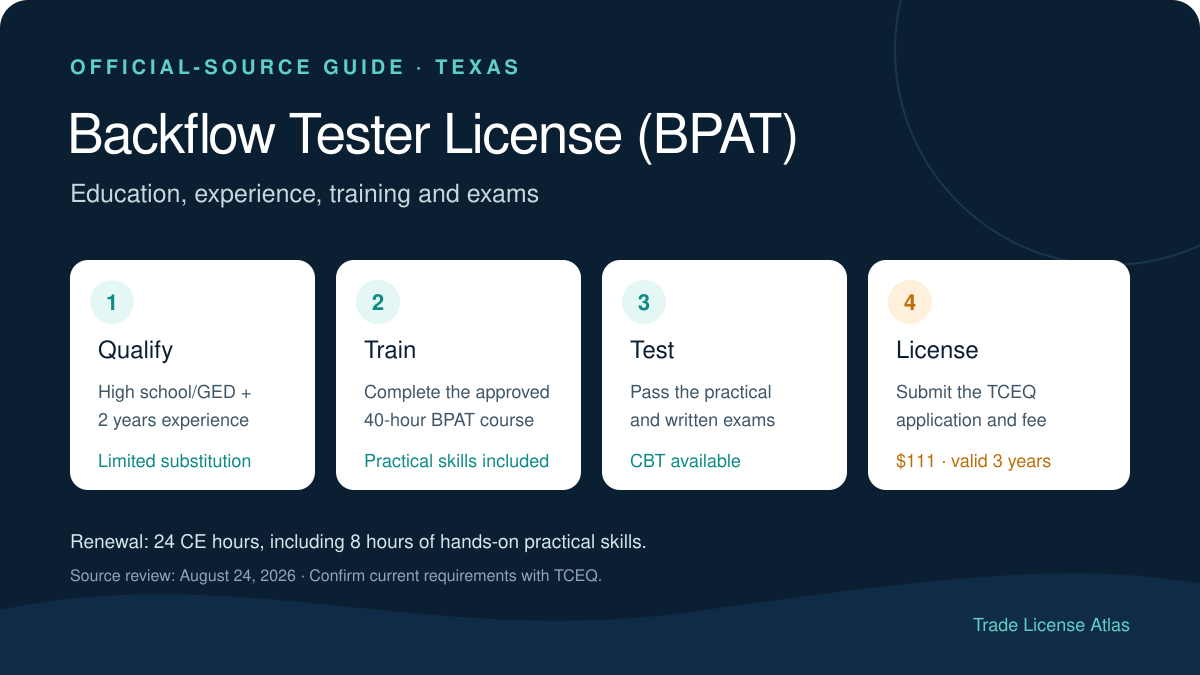
Texas backflow tester license requirements at a glance
| Requirement | BPAT rule |
|---|---|
| Education | High school diploma or GED |
| Experience | Two years in an approved work area, subject to a limited substitution |
| Core training | Approved 40-hour Backflow Prevention Assembly Tester course with practical skills |
| Examination | Provider-administered practical exam plus TCEQ written exam |
| Application fee | $111, excluding course tuition and provider charges |
| License term | Three years |
| Renewal education | 24 CE hours, including 8 practical hands-on hours |
The Texas backflow tester license is separate from a plumbing, irrigation, water-operator or fire-sprinkler credential. Those occupations can provide qualifying experience, but completing work under another license does not automatically grant BPAT authority. Use the license finder when comparing another occupation or state.
What work can a Texas BPAT perform?
TCEQ states that a licensed Backflow Prevention Assembly Tester may test and repair assemblies on domestic, commercial, industrial and irrigation services. Backflow assemblies protect potable water systems against contamination caused by reverse flow through a cross-connection.
Fire-line work has an important limitation. A BPAT may test and repair assemblies on fire lines only when permanently employed by an Approved Fireline Contractor. Holding the individual BPAT credential alone does not remove that employer condition.
Education and approved work experience
The standard Texas backflow tester license route requires a high school diploma or GED and two years of approved work experience. TCEQ lists several qualifying areas rather than restricting experience to one job title.
Examples of approved work include:
- Operating or maintaining a public drinking-water system.
- Installing or repairing residential, commercial or industrial drinking-water treatment equipment.
- Installing or repairing lawn-irrigation systems.
- Performing work that requires a master or journeyman plumbing license.
- Installing or servicing fire-suppression sprinkler systems and lines.
- Operating or maintaining a domestic wastewater-treatment facility.
- Performing qualifying health-inspection duties as a registered sanitarian.
- Other duties approved by the TCEQ executive director.
Experience substitution
An applicant with a high school diploma or GED may substitute up to one year of the required experience. TCEQ accepts either one year of college credit, defined as 32 semester hours, or 20 hours of additional approved training. The additional training must be beyond the required 40-hour BPAT course.
The substitution cannot remove both required years. Applicants should document dates, employers, job duties, college hours and course certificates clearly enough for TCEQ to determine whether the claimed experience falls within an approved area.
The required 40-hour BPAT course
Before taking the written examination for a Texas backflow tester license, an applicant must complete the TCEQ-approved Backflow Prevention Assembly Tester course with practical skills, identified by TCEQ as course code 1200. The licensing page describes it as a 40-hour course.
The course combines technical instruction with hands-on testing procedures. TCEQ maintains a searchable database of approved training providers. Use that database to confirm that the provider and scheduled course are approved for BPAT credit; a similarly named private course is not necessarily accepted.
The practical-skills examination is administered by the approved training provider. TCEQ separately administers the written portion through a regional office or an approved computer-based testing location.
Texas BPAT practical and written examinations
Practical-skills exam
The practical component is tied to the approved training course and evaluates the applicant’s ability to perform the hands-on procedures required of a tester. Because the provider administers this portion, ask about its scheduling, retest procedure and any provider charge before enrolling.
Written BPAT exam
After TCEQ reviews and approves the application, the applicant may register for the written BPAT examination. The written exam is available at TCEQ regional offices and approved computer-based testing centers. TCEQ highlights immediate scores and examination feedback as benefits of computer-based testing.
The written examination should not be scheduled until the application is approved. Keep the approval notice and use the exact personal information supplied to TCEQ when registering with the testing provider.
How to get a Texas backflow tester license
- Confirm the education requirement. Prepare proof of a high school diploma, GED or the documentation TCEQ requests.
- Document two years of approved experience. Describe duties, dates and employers rather than relying only on a job title.
- Calculate any permitted substitution. Use qualifying college credit or additional approved training for no more than one year of experience.
- Select an approved course. Find the 40-hour BPAT course in TCEQ’s training-provider database.
- Complete the course and practical exam. Retain the course certificate and practical-skills documentation.
- Submit the occupational license application. Use TCEQ’s Occupational Licensing Electronic Application and upload the supporting documents.
- Pay the $111 application fee. The fee is nonrefundable; verify the current amount before submission.
- Wait for TCEQ approval. Register for the written examination after the application has been reviewed and approved.
- Pass the written examination. Choose a TCEQ regional office or approved computer-based testing center.
Browse our trade-license directory and state directory for other regulated occupations. Texas also separately licenses Fire Alarm Technicians and electricians.
Texas backflow tester license cost
The TCEQ application fee for a new Texas backflow tester license is $111. This is not necessarily the total cost of becoming licensed. Applicants should also budget for:
- Tuition for the approved 40-hour BPAT course.
- Practical-examination or retest charges imposed by the training provider.
- Computer-based testing charges, when applicable.
- Travel, lodging, manuals and testing equipment.
- Additional approved training used for an experience substitution.
Course and provider pricing varies, so Trade License Atlas does not present a single total as a guaranteed quote. Confirm every charge with TCEQ, the selected provider and the testing center before paying.
BPAT renewal and continuing education
A Texas BPAT license is valid for three years. Before renewal, the license holder must complete 24 hours of TCEQ-approved continuing education. At least 8 of those 24 hours must be hands-on practical-skills training.
The CE hours must be completed before the license expires, even though Texas now allows certain late renewal applications. The renewal also requires an application, a criminal-history attestation and the applicable fee. TCEQ’s published normal renewal fee is $111.
For licenses expiring on or after September 1, 2025, TCEQ allows a late renewal application for up to 180 days after expiration, with higher fees. Applications submitted 1–90 days late are charged 1.5 times the normal fee; applications 91–180 days late are charged twice the normal fee. The late window does not extend the CE deadline.
A person who has submitted a renewal application and is no more than 90 days expired may continue licensed activity while the application is pending, subject to TCEQ’s current conditions. More than 180 days after expiration, the license cannot be renewed and the individual must meet the requirements for a new license again.
Out-of-state BPAT reciprocity
TCEQ may waive qualifications, training or an examination for an out-of-state occupational license on a case-by-case basis, except for landscape irrigators. This is not automatic reciprocity.
An applicant must hold a current license issued by another state, territory or country, have obtained that license through an examination, and remain in good standing with a satisfactory compliance history. The applicant uses OLEA, completes the reciprocity section, pays the $111 fee and uploads the current license and applicable course certificates.
TCEQ contacts the issuing authority and determines what Texas license, if any, the outside credential equates to. Use our license reciprocity tool as a starting point, but rely on TCEQ’s written decision for the actual result.
BPAT application checklist
- High school diploma or GED documentation.
- Detailed record of two years of approved work experience.
- College transcript or extra training certificates if claiming an experience substitution.
- Certificate for the approved 40-hour BPAT course.
- Proof of completing the provider-administered practical examination.
- Completed TCEQ electronic occupational-license application.
- $111 application fee.
- TCEQ approval before written-exam registration.
- Copies of every submitted document and payment confirmation.
Frequently asked questions
How long is the Texas BPAT course?
TCEQ requires the approved 40-hour Backflow Prevention Assembly Tester course with practical skills.
Can college replace BPAT work experience?
Partly. An applicant with a high school diploma or GED may substitute up to one of the two experience years with 32 semester hours of college credit. The other year must still be documented through approved experience.
Can extra training replace experience?
Up to one year may be replaced by 20 hours of additional approved training beyond the mandatory 40-hour BPAT course.
Can a BPAT test a backflow assembly on a fire line?
Only when the tester is permanently employed by an Approved Fireline Contractor, according to TCEQ’s BPAT licensing page.
How long is a Texas backflow tester license valid?
The BPAT license is valid for three years. Renewal requires 24 CE hours, including 8 practical hours.
How much is the BPAT application fee?
The current TCEQ fee is $111. Course tuition and provider testing charges are additional.
Does Texas automatically accept another state’s backflow license?
No automatic transfer is promised. TCEQ evaluates occupational-license reciprocity individually and may waive particular requirements after verifying the outside license and examination history.
Official sources used
- TCEQ Backflow Prevention Assembly Tester licensing requirements
- TCEQ approved training courses and providers
- TCEQ computer-based occupational license testing
- TCEQ Occupational Licensing Electronic Application instructions
- BPAT renewal and continuing-education requirements
- TCEQ out-of-state occupational license reciprocity
Verified licensing details
- Jurisdiction
- Statewide license
- Licensing authority
- Texas Commission on Environmental Quality (TCEQ)
- Fees
- TCEQ charges a $111 application fee for a new BPAT license. Approved course tuition and any computer-based testing charges are separate. The normal renewal fee is also $111; late-renewal multipliers may apply.
- Experience
- High school diploma or GED plus two years of approved work experience. Up to one year may be substituted with 32 semester hours of college credit or 20 hours of additional approved training beyond the required BPAT course.
- Exams
- Complete the approved 40-hour Backflow Prevention Assembly Tester course, including its provider-administered practical-skills examination, and pass the written BPAT examination through a TCEQ regional office or approved computer-based testing center.
- Insurance or bond
- TCEQ does not list a personal insurance or bond requirement for the individual BPAT license. Separate employer, local program, plumbing, irrigation, or Approved Fireline Contractor requirements may apply to particular work.
- Continuing education
- Complete 24 hours of TCEQ-approved continuing education before renewal, including at least 8 hours of hands-on practical-skills training.
- Renewal period
- Three years. Renewal requires the continuing-education hours, a renewal application, criminal-history attestation, and the applicable fee.
Official sources
Official sources last checked August 23, 2026.
Requirements can change and local rules may apply. Confirm the current requirements with the official authority before paying a fee or beginning work.