
Official-source review: August 24, 2026
A Texas low voltage license is not one universal credential. Texas regulates low-voltage work by the system’s purpose: data and communications cabling can fall under an electrician-license exemption, security alarms and electronic access control are regulated by the Department of Public Safety, and fire alarm work follows a separate State Fire Marshal licensing program.
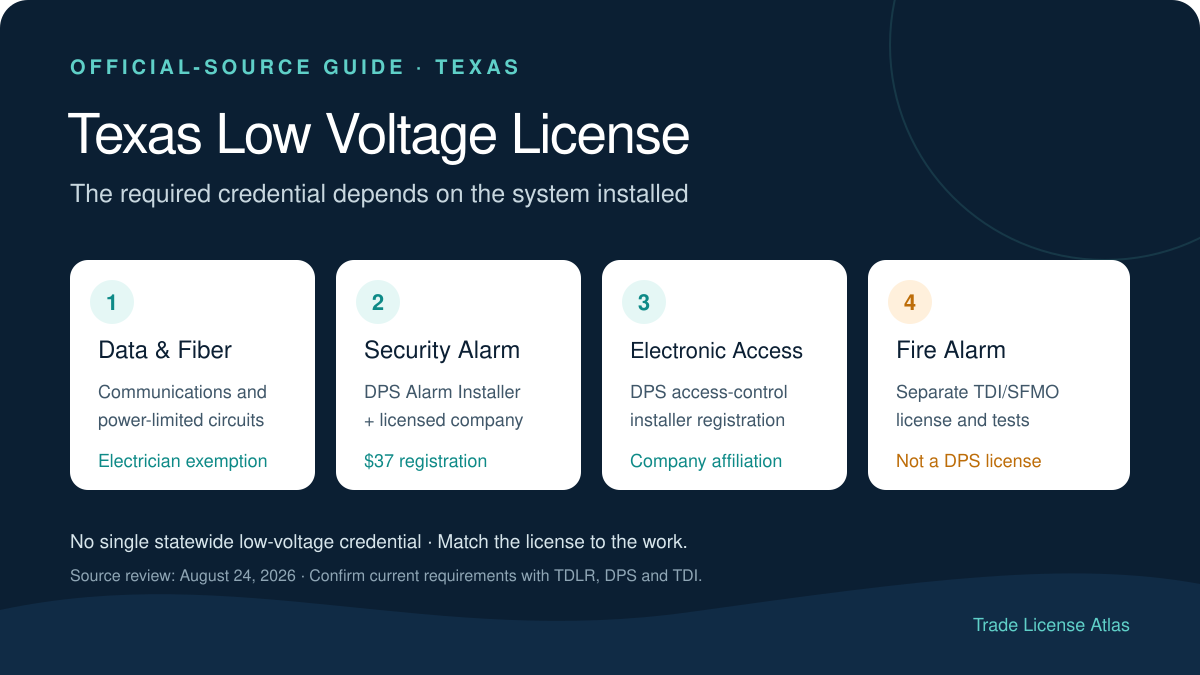
Texas low voltage license requirements at a glance
| Work performed | Primary state rule | Likely credential |
|---|---|---|
| Ethernet, telephone, optical fiber and qualifying communications circuits | TDLR electrician-license exemption | No state electrician license for work fully within the exemption |
| Class 1, 2 or 3 remote-control, signaling or power-limited circuits | TDLR electrician-license exemption | No electrician license when the work stays within the exempt circuit |
| Burglar, intrusion or security-alarm system | DPS Private Security Program | Alarm Installer individual license plus licensed-company affiliation |
| Electronic access control, monitored entry or logged ingress/egress | DPS Private Security Program | Electronic Access Control Device Installer license plus company affiliation |
| Fire alarm or fire-detection system | TDI State Fire Marshal’s Office | FAL, RAL or another SFMO license matching the work |
| Line-voltage supply, service, branch circuit or non-exempt electrical work | TDLR Electricians Program | Appropriate electrician and electrical-contractor licensing |
The phrase “low voltage” alone does not determine licensing. A network cable and an alarm-system conductor can operate at similar voltage while falling under different statutes. Choosing the correct Texas low voltage license route requires identifying the system function, the person doing the work, the company offering the service and every line-voltage connection.
Data, telecom and power-limited wiring exemptions
TDLR states that people performing electrical work on Class 1, 2 or 3 remote-control, signaling or power-limited circuits, fire alarm circuits, optical fiber cables or communications circuits are not required by the state to hold an electrician license. The exemption comes from Texas Occupations Code §1305.003(a)(12).
Typical projects that may fit include structured data cabling, Ethernet drops, telephone cabling, fiber-optic installation and certain control or signaling circuits. The installer should still confirm that every part of the scope remains within the statutory exemption.
The TDLR exemption also does not automatically cover installation of the power source feeding low-voltage equipment. If a project adds a 120-volt receptacle, new branch circuit, service equipment or other non-exempt electrical connection, that portion generally belongs under the Texas electrician-licensing framework.
Texas security alarm installer license
A person installing or servicing a burglar, intrusion or other regulated security-alarm system uses the DPS Private Security route. DPS lists Alarm Installer as an individual license. The individual must also be affiliated with a company or entity licensed by DPS; the pocket card is not issued as a stand-alone authority to offer services independently.
This Texas low voltage license route is submitted through Texas Online Private Security, known as TOPS. New applicants complete a fingerprint-based FBI criminal-history check. DPS can request court or eligibility documentation during its review, and an applicant with disqualifying history may be denied.
Alarm Level I training
Initial registration does not require the Alarm Level I course to be finished before the application. During the first 12 months, however, the Alarm Installer must complete 16 hours of DPS-approved Alarm Level I training, including two hours covering the National Electrical Code as it applies to low voltage.
Until that training is complete, the installer’s work must be overseen by an installer who has completed the 16 hours. The rule says the oversight need not be constant direct physical supervision, but the overseeing licensee is responsible for ensuring that the installation complies with applicable requirements.
Alarm pre-wiring
DPS specifically addresses “pre-wiring” by builders. Wiring that would not exist but for the alarm system and is essential or unique to that system is treated as part of the regulated alarm installation. A limited builder exception requires direct supervision, inspection and certification by a licensed alarm installer who assumes responsibility; it is not a general exemption for alarm subcontractors.
Electronic access-control installer license
Texas DPS separately lists Electronic Access Control Device Installer as an individual license. This route applies when the installed system controls, monitors or records access rather than merely operating a door or gate for convenience.
DPS explains that a basic gate or garage-door operator does not require private-security licensing when no other Chapter 1702 activity occurs. The conclusion changes if the operator connects to an alarm system or allows monitoring or logging of entry and exit. In that case, a private-security credential is required.
Examples that can enter the regulated access-control category include card-reader systems, credentialed electronic locks, biometric readers and systems that log ingress or egress. Because door hardware can also affect required emergency egress, the project may need local building or fire-marshal approval even after the state licensing issue is resolved.
This Texas low voltage license category does not have a DPS training or examination prerequisite for initial individual licensure. Electronic Access Control Device Installer applicants still need the application, fingerprints, eligibility review and affiliation with a properly licensed company. General continuing-education rules apply before renewal.
Fire alarm systems use a separate license
The electrical-law exemption for a fire-alarm circuit does not eliminate fire-alarm licensing. Texas regulates companies and individuals who plan, install, certify, service, monitor or maintain fire-detection systems through the Texas Department of Insurance State Fire Marshal’s Office.
A Fire Alarm Technician may sell, install, certify, service and monitor covered systems but cannot plan them. The current route requires the TFM11 statutes-and-rules test and TFM12 technical test, fingerprints and employment by a registered fire-alarm company. TDI recognizes limited technical-test alternatives through qualifying ESA or NICET credentials.
Use our detailed Texas Fire Alarm Technician license guide for individual license types, examinations, fees, company registration and insurance. Do not use the DPS Alarm Installer application for work regulated by SFMO.
When a Texas electrician license is required
The low-voltage exemption is defined by the circuit and work performed, not by a contractor’s marketing description. Non-exempt electrical work must be handled by someone holding the correct TDLR credential and, when offered to the public, through a licensed Electrical Contractor with a Master Electrician of Record.
Common scope boundaries that deserve review include:
- Installing a new line-voltage branch circuit or receptacle for low-voltage equipment.
- Altering service equipment, panelboards or non-exempt power wiring.
- Combining exempt signaling conductors with electrical work outside Class 1, 2 or 3 limitations.
- Connecting equipment where another occupational exemption does not cover the power connection.
See the Texas electrician license guide for apprentice, journeyman, master and electrical-contractor requirements. A business may need both appropriately licensed electrical personnel and DPS-licensed security installers when one project crosses both scopes.
How to determine and obtain the correct license
- Define the system function. Record whether the project carries data, detects intrusion, controls access, detects fire or supplies line-voltage power.
- Separate each work scope. Do not treat a multi-system project as one generic low-voltage installation.
- Check the TDLR exemption. Confirm whether the data, fiber or power-limited wiring fits the language of §1305.003.
- Select the DPS credential. Choose Alarm Installer or Electronic Access Control Device Installer for regulated private-security work.
- Confirm the employer’s license. DPS individual licenses require affiliation with an appropriately licensed company or entity.
- Apply through TOPS. Submit the individual application and fee and follow the generated checklist.
- Complete fingerprints. Use the DPS/IdentoGO instructions generated after a paid application.
- Complete required training. Alarm Installers finish 16-hour Alarm Level I during the first 12 months.
- Use the SFMO route for fire alarms. Complete the separate tests, fingerprint and employer-registration conditions.
- Check local permits. Access-controlled doors, alarms, fire systems and electrical work can require city or county approval.
Browse the license finder, trade directory and state directory for other occupations and jurisdictions.
Company license requirements
An individual Texas low voltage license for alarm or access-control work must be connected to a licensed private-security company. DPS describes Class B as a Security Contractor Company license that can include alarm and electronic-access services, among other regulated categories.
A Class B company representative for a non-guard category generally needs two consecutive years of verifiable full-time experience in each service category requested. The representative also takes a two-hour open-book examination covering Chapter 1702 and Chapter 35. The test has 50 true/false and multiple-choice questions, and the passing score is 70%.
If the primary representative does not qualify in every category offered, the business must designate an additional qualified representative for the uncovered service. The company application, owners, background checks, representative qualifications, insurance and corporate documentation are separate from each technician’s individual application.
Texas low-voltage application fees
| License or service | Published DPS charge |
|---|---|
| Alarm Installer individual license | $37 original or renewal |
| Electronic Access Control Device Installer | $37 original or renewal |
| New-applicant FBI fingerprint check | $28.25 |
| Class B Security Contractor Company | $412 original or renewal |
| Company-representative re-examination | $100 |
The individual total can also include training tuition, continuing education, local permits, tools and employer-specific requirements. A company has additional insurance and organizational costs. Fire-alarm applicants pay the separate TDI/SFMO fees described in the fire-alarm guide.
Always recheck the current DPS fee schedule before paying. Government fees can change, and a late renewal costs more than an on-time renewal.
Renewal and continuing education
DPS individual private-security licenses issued to new applicants generally expire two years after issuance. A holder using a regulated Texas low voltage license route must complete the required approved education before submitting the renewal.
After the initial Alarm Level I period, an Alarm Installer completes eight hours of alarm-related continuing education during each subsequent 24-month period. At least one hour must cover the NEC as it applies to low voltage.
An Electronic Access Control Device Installer falls under the general rule for individual license types not otherwise given a special requirement: eight total hours, consisting of seven hours related to the licensed specialty and one hour of ethics. The employing company keeps proof in the personnel file, and the licensee certifies completion during renewal.
Continuing-education credit must come from a DPS-approved school and fall within the applicable license period. If the required education is incomplete, the holder is not eligible to renew until the deficiency is satisfied.
Out-of-state licenses and reciprocity
DPS states that Texas has no reciprocal agreements accepting private-security licenses from another state. An out-of-state alarm or access-control license therefore does not automatically become a Texas low voltage license.
Lawful experience obtained elsewhere may help an applicant satisfy a company-representative experience requirement, but DPS still evaluates the application and requires the Texas examination where applicable. Use the license reciprocity checker for orientation, then obtain confirmation from the correct agency.
Low-voltage project checklist
- Written description of each system and circuit installed.
- TDLR exemption checked for data, fiber and power-limited work.
- DPS Alarm Installer license for regulated security-alarm work.
- DPS Electronic Access Control Device Installer license for regulated access systems.
- Active affiliation with the correct licensed company.
- Alarm Level I training status and required oversight documented.
- Separate SFMO license confirmed for fire-alarm activity.
- Licensed electrician assigned to non-exempt power connections.
- Local building, electrical, fire and alarm permits checked.
- Current licenses verified through the applicable public database.
Frequently asked questions
Does Texas have a general low-voltage contractor license?
No. Texas divides the work by system type. Communications wiring can be exempt from electrician licensing, while security alarms, electronic access and fire alarms have separate regulatory routes.
Do I need an electrician license to install Ethernet cable?
TDLR lists communications circuits and optical fiber among the state electrician-license exemptions. The exemption does not cover unrelated line-voltage work or remove permits and other system-specific rules.
Can I install burglar-alarm wire under the low-voltage exemption?
The electrical exemption does not remove DPS private-security licensing. DPS treats wiring essential and unique to an alarm system as part of the regulated alarm installation.
Does an Alarm Installer need training before applying?
The 16-hour Alarm Level I course must be completed during the first 12 months. Until completion, work must be overseen by an installer who has completed the training.
Is access-control installation licensed in Texas?
Yes, when it falls within regulated electronic access control. DPS issues an Electronic Access Control Device Installer license and requires affiliation with a licensed company.
Does a basic gate opener require a DPS license?
Not when the installer performs no other regulated activity and the operator only provides convenient activation. A connection to an alarm or a system that monitors or logs ingress and egress changes the result.
Does a DPS Alarm Installer license cover fire alarms?
No. Fire alarm work is regulated separately through the Texas Department of Insurance State Fire Marshal’s Office.
How much is an individual Texas low voltage license?
For the regulated DPS routes discussed here, the current fee is $37 for either an Alarm Installer or Electronic Access Control Device Installer license. Fingerprints, training and employer or company costs are separate.
Official sources used
- TDLR electrician-license exemptions, including low-voltage wiring
- Texas Occupations Code Chapter 1305
- DPS individual private-security license types
- DPS licensing, TOPS and official fee schedule
- DPS fingerprinting instructions
- DPS training and continuing-education overview
- DPS alarm-system pre-wiring interpretation
- DPS gate and garage-door operator guidance
- DPS Class B company-representative requirements
- DPS company-license types
- TDI fire-alarm registration, licenses, tests and fees
Verified licensing details
- Licensing authority
- Texas Department of Licensing and Regulation (TDLR), Texas Department of Public Safety (DPS), and Texas Department of Insurance (TDI)
- Fees
- DPS lists $37 for an original or renewal Alarm Installer or Electronic Access Control Device Installer license and a separate $28.25 fingerprint charge for a new applicant. A Class B security contractor company license is $412. Fire alarm licensing follows separate TDI fees.
- Experience
- Texas does not issue one generic low-voltage credential. Data, fiber and qualifying power-limited circuits are exempt from the state electrician license. Security alarm and electronic-access work requires the corresponding DPS individual license and affiliation with a licensed company. Company representatives generally need two consecutive years of full-time experience in each Class B service category.
- Exams
- DPS does not list an initial examination for an individual Alarm Installer or Electronic Access Control Device Installer. An Alarm Installer must complete 16-hour Alarm Level I training during the first 12 months. A Class B company representative must pass a two-hour, 50-question open-book exam with at least 70%. Fire alarm work has separate SFMO testing.
- Insurance or bond
- Individual DPS installer pages do not state a separate personal insurance requirement. The employing security company is responsible for its company-license and insurance obligations. Fire alarm companies follow separate TDI liability-insurance rules.
- Continuing education
- Alarm Installers complete 16-hour Alarm Level I training during the first 12 months, including 2 hours of low-voltage NEC, then 8 hours of alarm-related CE during each later two-year period, including 1 NEC hour. Other individual licenses generally complete 8 hours: 7 specialty hours and 1 ethics hour.
- Renewal period
- DPS individual private-security licenses generally expire two years after issuance. Required training or continuing education must be completed before renewal.
Official sources
Official sources last checked August 23, 2026.
Requirements can change and local rules may apply. Confirm the current requirements with the official authority before paying a fee or beginning work.