
Official-source review: August 24, 2026
A Texas home inspector license is issued by the Texas Real Estate Commission and comes in three levels: Apprentice Inspector, Real Estate Inspector and Professional Real Estate Inspector. The right starting point depends on whether an applicant will gain supervised field experience or use TREC’s substitute-education route.
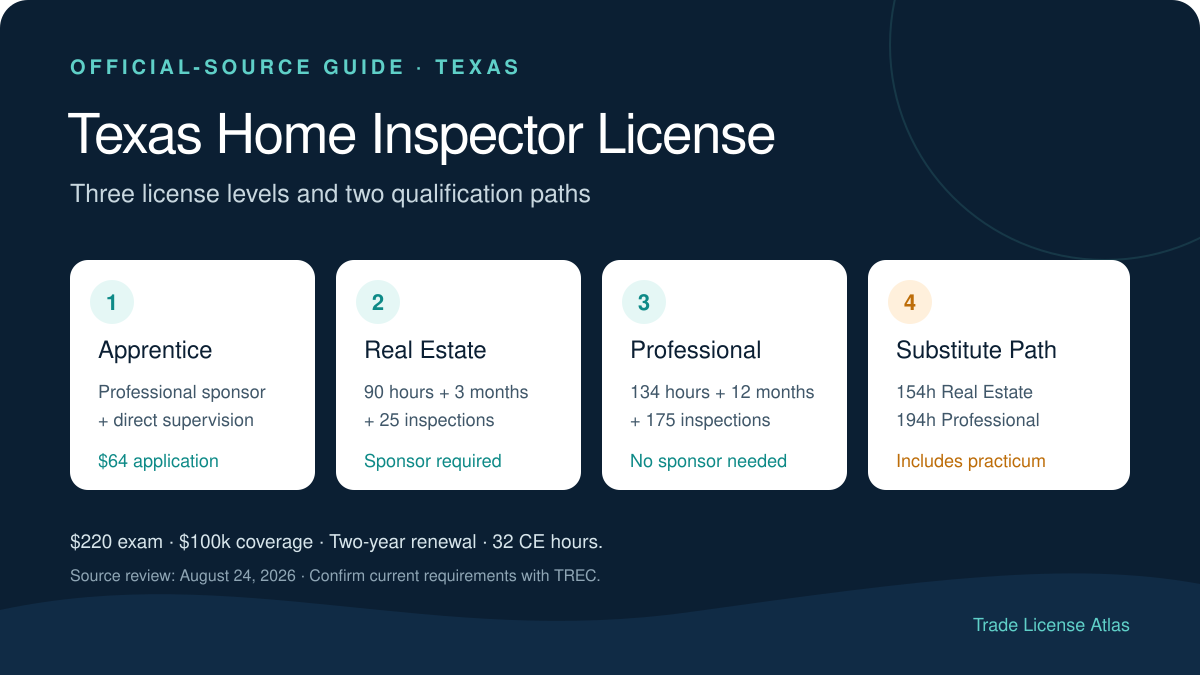
Texas home inspector license requirements at a glance
| License route | Main qualification | Education | Published initial fee |
|---|---|---|---|
| Apprentice Inspector | Qualifying Professional Inspector sponsor; direct supervision | No prelicense course listed | $60 + $4 online |
| Real Estate Inspector, sponsored | Three active Apprentice months and 25 directly supervised inspections | 90 qualifying hours | $100 + $4 online |
| Real Estate Inspector, substitute | Education route rather than Apprentice experience | 114 qualifying hours + 40-hour practicum | $100 + $4 online |
| Professional Inspector, sponsored | 12 active Real Estate Inspector months and 175 indirectly supervised inspections | 134 qualifying hours | $120 + $4 online |
| Professional Inspector, substitute | Education route rather than lower-level license experience | 154 qualifying hours + 40-hour practicum | $120 + $4 online |
The $220 inspector examination and $37 fingerprint charge, when fingerprints are not already on file for TREC, are separate. Private-school tuition and the required financial-responsibility coverage also vary. Use the license finder to compare this pathway with another trade or jurisdiction.
The three Texas inspector license levels
Apprentice Inspector
Apprentice is the entry-level Texas home inspector license. The applicant must be at least 18, be a U.S. citizen or lawfully admitted alien, meet TREC’s standards for honesty, trustworthiness and integrity, and be sponsored by a qualifying Professional Inspector.
An Apprentice performs inspections only under the direct supervision of the sponsor. TREC does not list a prelicense education or examination requirement for this entry level, but fingerprints, the background check, sponsorship and financial-responsibility documentation still apply. The application must be completed within one year after filing.
Real Estate Inspector
This intermediate license allows inspections under the indirect supervision of a Professional Inspector. An applicant may qualify by progressing from Apprentice experience or by completing the substitute-education path. Either way, an active Real Estate Inspector needs a Professional Inspector sponsor.
Professional Real Estate Inspector
Professional Inspector is the highest Texas home inspector license level. A Professional may inspect without a sponsor and may sponsor lower-level inspectors after TREC confirms sponsor eligibility. The applicant can progress from an active Real Estate Inspector license or use the longer substitute-education route.
How to qualify as a Real Estate Inspector
Sponsored experience route
The sponsored route requires at least three months of active experience as an Apprentice Inspector during the 12 months before application and at least 25 complete inspections performed under direct supervision. TREC also requires 90 classroom hours:
- 40 hours in Property and Building Inspection Module I.
- 40 hours in Property and Building Inspection Module II.
- 10 hours in Business Operations and Professional Responsibilities.
The applicant then completes the fingerprint and background process, obtains exam eligibility, passes the national and state exam portions, secures a sponsor and files proof of at least $100,000 per occurrence financial responsibility.
Substitute-education route
An applicant can seek the Real Estate Inspector credential without first spending three months as an Apprentice. This route requires the same 90 hours above, plus 24 hours in Texas Standards of Practice and a 40-hour Texas Practicum. That is 114 hours of qualifying classroom education plus the practicum, or 154 hours altogether.
The substitute route still requires both examination portions, fingerprints, the background review, financial responsibility and a sponsor. It replaces the Apprentice tenure and 25-inspection condition; it does not create an unsupervised Real Estate Inspector license.
How to qualify as a Professional Inspector
Sponsored experience route
The progressive route requires at least 12 months of active experience as a Real Estate Inspector during the 24 months before applying. The applicant must document 175 completed inspections under indirect supervision and complete 134 qualifying hours:
- 40 hours in Property and Building Inspection Module I.
- 40 hours in Property and Building Inspection Module II.
- 10 hours in Business Operations and Professional Responsibilities.
- 20 hours in Texas inspector law.
- 24 hours in Texas Standards of Practice.
After satisfying the remaining application, fingerprint, exam and coverage conditions, the Professional Inspector may operate without a sponsor. This is the ordinary progression for someone who wants substantial field experience before working independently.
Substitute-education route
The direct education route to a Professional Texas home inspector license requires 154 qualifying classroom hours plus the 40-hour Texas Practicum, for 194 total hours. The classroom subjects are:
- 40 hours in Property and Building Inspection Module I.
- 40 hours in Property and Building Inspection Module II.
- 10 hours in Business Operations and Professional Responsibilities.
- 20 hours in Analysis of Findings and Reporting.
- 20 hours in Texas inspector law.
- 24 hours in Texas Standards of Practice.
This path removes the 12-month Real Estate Inspector tenure and 175-inspection condition. It does not remove the national and state examinations, fingerprints, background review or $100,000 coverage requirement.
Credit for related experience
TREC may award credit for Property and Building Inspection Modules I and II when the applicant documents at least three years of qualifying experience in a field directly related to home inspection. The official application requires supporting affidavits from two people familiar with that work. Applicants should obtain a written TREC determination rather than assuming construction experience automatically removes 80 hours.
What is the 40-hour Texas Practicum?
The Texas Practicum is a structured field component used in the substitute routes. A student must finish the required qualifying coursework before starting it. The practicum lasts at least 40 hours and includes a minimum of five complete, in-person inspections conducted under an eligible instructor.
The training provider must limit each instructor to no more than four students during a practicum inspection. Students prepare reports, receive evaluations and must demonstrate satisfactory performance. A casual ride-along that is not part of an approved practicum does not automatically satisfy the requirement.
How to get a Texas home inspector license
- Choose a license level and route. Compare supervised progression with substitute education before enrolling or filing.
- Select TREC-approved education. Verify the provider and exact course names in TREC’s education database.
- Complete the required experience or practicum. Keep inspection logs, supervision records, course certificates and reports.
- Submit the application. Use the application matching Apprentice, Real Estate or Professional status and complete it within one year.
- Complete fingerprints. Follow TREC’s vendor instructions when qualifying fingerprints are not already on file.
- Obtain examination eligibility. TREC reviews education and experience before the applicant schedules the required portions.
- Pass the inspector examination. Real Estate and Professional applicants take national and Texas state portions.
- Arrange financial responsibility. File proof of at least $100,000 per occurrence coverage before active issuance.
- Add a sponsor when required. Apprentice and Real Estate applicants need a qualifying Professional Inspector.
- Verify active status. Do not perform regulated inspections until TREC’s public record shows the correct active license and sponsor.
Related Texas licensing guides cover HVAC contractors, electricians, plumbers and backflow testers. Browse the trade directory or state directory for additional routes.
National and Texas state examinations
Real Estate and Professional Inspector applicants take both the national and state portions of the inspector examination. TREC’s rules identify the national portion as the National Home Inspector Examination. The state portion tests Texas law, Standards of Practice and related state-specific requirements.
The published examination-provider fee is $220. A Real Estate Inspector applicant must score at least 70% on the state portion; a Professional Inspector applicant needs at least 75%. Passing examination results remain valid for one year.
Education sequencing depends on the route. Before the national portion, candidates complete the required property-inspection modules and business course; Professional substitute applicants also complete Analysis of Findings and Reporting. Texas law, Standards of Practice and the practicum are required before the state portion when applicable.
After three failed attempts, TREC requires additional qualifying education before another attempt. Candidates should use the current exam-provider bulletin and TREC approval notice because scheduling, identification and retest rules can change.
Texas home inspector license fees and total cost
TREC’s fee schedule effective December 15, 2025 lists the following online totals:
| Item | Published charge |
|---|---|
| Apprentice Inspector original application | $60 + $4 online = $64 |
| Real Estate Inspector original application | $100 + $4 online = $104 |
| Professional Inspector original application | $120 + $4 online = $124 |
| Inspector examination | $220 paid to the examination provider |
| Fingerprint collection | $37 when new fingerprints are required |
Those charges are not the entire cost. Applicants should also budget for approved education, practicum tuition, study materials, retesting, travel and the required insurance or other permitted financial-responsibility arrangement. Provider prices and insurance premiums vary, so a single advertised “total license cost” should not be treated as a TREC quote.
Fingerprints and background review
Every level requires TREC to determine that the applicant meets its standards for honesty, trustworthiness and integrity. Applicants who have not previously been fingerprinted for TREC follow the authorized fingerprint process and pay the current $37 collection fee.
A criminal history does not produce the same result in every case. Someone concerned about eligibility can request a fitness determination before committing to the entire course path. TREC lists $50 plus a $4 online-processing fee for that request.
Financial responsibility requirement
Before TREC issues or renews an active Texas home inspector license, the applicant must show professional liability insurance or another permitted form of insurance covering the relevant statutory violations. The minimum is $100,000 per occurrence.
Coverage must remain current while the inspector is active. Because policies, exclusions and premiums differ, applicants should use TREC’s exact certificate and coverage rules when comparing insurance rather than relying only on a generic business-liability quote.
Renewal, inactive status and continuing education
Texas inspector licenses renew every two years. An active license holder completes 32 hours of approved continuing education, including the 8-hour Inspector Legal & Ethics and Standards of Practice Review course. No more than 16 hours may come from a single subject.
The online renewal totals are $34 for Apprentice, $54 for Real Estate Inspector and $64 for Professional Inspector. Apprentice and Real Estate Inspectors need a qualifying sponsor and current financial-responsibility evidence for active renewal. Professional Inspectors need the coverage but not a sponsor.
An inspector may renew inactive without CE, insurance or sponsorship, but cannot perform inspections while inactive. A late renewal is available for up to six months after expiration with additional fees. More than six months late requires a new initial application; after two years, the former licensee must reapply and pass the examination again.
Out-of-state licenses and Texas reciprocity
Texas has no reciprocity agreement for inspectors with any other state. An out-of-state license does not automatically become a Texas home inspector license. The applicant must satisfy the current Texas education, experience, examination, fingerprint, coverage and sponsorship rules for the selected level.
Related construction experience may support a request for Module I and II credit, but TREC decides whether the documented work qualifies. Use the license reciprocity checker for orientation and rely on TREC’s written determination before paying for a particular route.
Application checklist
- Chosen license level and sponsored or substitute path.
- TREC-approved course certificates for every required subject.
- Inspection logs and sponsor verification for the experience route.
- Approved 40-hour Texas Practicum record for a substitute route.
- Related-experience affidavits when requesting Module I or II credit.
- Correct TREC application and online payment.
- Fingerprint receipt or confirmation that TREC already has fingerprints.
- Examination eligibility notice and current provider instructions.
- Proof of at least $100,000 per occurrence financial responsibility.
- Qualifying sponsor for Apprentice or Real Estate Inspector status.
Frequently asked questions
Can I become a Texas home inspector without being an Apprentice?
Yes. TREC offers substitute-education routes for Real Estate and Professional Inspector applicants. These require additional qualifying education and a 40-hour Texas Practicum instead of the lower-level license tenure and inspection counts.
How many inspections are required for the experience route?
Real Estate Inspector requires 25 complete inspections under direct supervision after at least three active Apprentice months. Professional Inspector requires 175 inspections under indirect supervision after at least 12 active Real Estate Inspector months.
Does an Apprentice Inspector need a course or exam?
TREC’s Apprentice application page does not list prelicense education or an examination. Sponsorship, fingerprints, background eligibility, financial responsibility and direct supervision still apply.
How much is the Texas inspector exam?
TREC’s current fee schedule lists $220, paid to the examination provider. Application, fingerprints, education, insurance and retesting are separate.
Can a Real Estate Inspector work without a sponsor?
No. The intermediate license operates under a Professional Inspector’s indirect supervision. Independent work requires the Professional Real Estate Inspector credential.
How often does a Texas inspector license renew?
Every two years. Active renewal requires 32 CE hours, including the mandatory 8-hour legal, ethics and Standards of Practice review course.
Does Texas recognize another state’s home inspector license?
Not through reciprocity. TREC states that Texas has no reciprocity agreement with another state, so the applicant must meet the current Texas requirements.
Official sources used
- TREC inspector license levels and application routes
- TREC Apprentice Inspector requirements
- TREC Real Estate Inspector requirements
- TREC Professional Real Estate Inspector requirements
- TREC qualified Professional Inspector sponsor list
- TREC Texas Practicum guidance
- TREC inspector renewal and continuing-education rules
- TREC fee schedule effective December 15, 2025
- TREC inspector reciprocity answer
- TREC administrative rules
Verified licensing details
- Jurisdiction
- Statewide license
- Licensing authority
- Texas Real Estate Commission (TREC)
- Fees
- Including the $4 online-processing charge, initial applications are $64 for Apprentice Inspector, $104 for Real Estate Inspector and $124 for Professional Inspector. The inspector examination is $220 and fingerprints are $37 when required. Education tuition and insurance are separate.
- Experience
- Sponsored Real Estate route: three months as an active Apprentice and 25 directly supervised inspections. Sponsored Professional route: 12 months as an active Real Estate Inspector and 175 indirectly supervised inspections. TREC also offers substitute-education paths with a 40-hour Texas Practicum.
- Exams
- Real Estate and Professional Inspector applicants must pass the national and Texas state portions of the inspector examination. TREC lists a $220 examination fee. The state-part passing score is 70% for Real Estate Inspector and 75% for Professional Inspector.
- Insurance or bond
- Before an active inspector license is issued or renewed, the applicant must provide proof of professional liability insurance or another permitted form of financial responsibility with at least $100,000 per occurrence coverage.
- Continuing education
- Active inspectors must complete 32 hours of approved continuing education for each two-year renewal, including the 8-hour Inspector Legal & Ethics and Standards of Practice Review course. No more than 16 hours may come from one subject.
- Renewal period
- Two years. Apprentice and Real Estate Inspectors need a qualifying sponsor to renew active; a Professional Inspector does not. Inactive renewal avoids CE and insurance but prohibits inspection activity.
Official sources
Official sources last checked August 23, 2026.
Requirements can change and local rules may apply. Confirm the current requirements with the official authority before paying a fee or beginning work.