
Official-source review: August 25, 2026
Florida low voltage license: The principal statewide business credential is the Certified Electrical Specialty Contractor license with a Limited Energy Systems Specialty qualification (ES). A registered ET specialty route is limited to the jurisdictions where local competency is accepted.
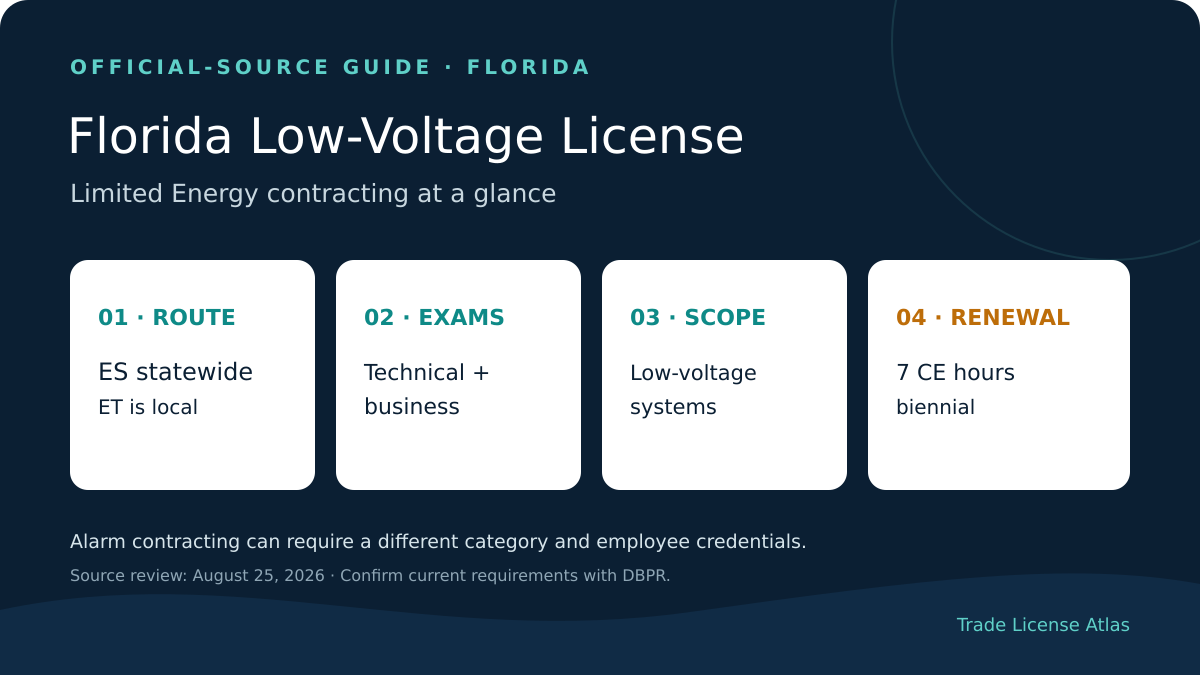
What the Florida low voltage license covers
ES Limited Energy is the scalable statewide route for a contracting business. ET serves contractors whose competency is based on a local jurisdiction and is not portable everywhere.
- Limited-energy systems within the statutory specialty scope.
- Communications, signaling and other qualifying low-voltage systems.
- Statewide contracting under certified ES qualification.
- Local work under registered ET qualification.
- Business qualification and project permits.
For employee alarm credentials, see the Florida FASA/BASA guide.
Florida low voltage license requirements at a glance
| Requirement | Current rule or route |
|---|---|
| Statewide route | ES — Limited Energy Systems Specialty |
| Local route | ET registered specialty |
| Exam | Technical/safety and business |
| Experience | Electrical-board pathway for category |
| Initial listed fees | $263.25 + $123.75 exam; $296 active license |
| CE | 7 hours |
| Renewal | August 31 even years |
Do not treat this table as an approval notice. The agency, certification organization or local jurisdiction makes the final eligibility decision and may request additional evidence.
How to complete the Florida low voltage license process
- Confirm that the systems fit Limited Energy rather than unlimited electrical or alarm scope.
- Apply for the certified specialty examination.
- Pass technical/safety and business.
- Document experience and financial responsibility.
- Apply for initial ES licensure and qualify the business.
- Check alarm-agent and local permit requirements.
Keep copies of every experience certificate, examination result, bond or insurance filing and payment receipt. Names and business entities should match across the application and supporting documents.
Important Florida rules and boundaries
- Limited Energy contracting authority is not the same as an employee FASA or BASA card.
- Registered ET authority remains geographically limited.
- Fire and burglar alarm work can trigger separate contractor categories and agent training.
- Work outside the limited-energy specialty can require EC authority.
Florida may separate the credential held by a worker from the contractor license held by the business, while preserving local authority over permits and inspections. Confirm every applicable layer before bidding, advertising or beginning regulated work.
Florida low voltage license cost and renewal
The listed examination and initial active license charges total $683 before financial reports, insurance, preparation and business costs.
Certified specialty licenses renew on August 31 of even-numbered years with seven hours of approved CE.
Government charges are only part of the expected cost. Training, examination preparation, fingerprints, surety premiums, insurance, equipment calibration and local permits can add to the total.
Florida low voltage license checklist
- Confirm that this credential matches the exact work you will perform.
- Check whether the applicant is an individual, sole owner or separate business entity.
- Collect experience and training records before submitting the application.
- Use the current official form and fee schedule.
- Complete every required examination or approved certification route.
- File bonds, insurance and fingerprints when applicable.
- Check county, city, water supplier and building-permit rules.
- Save the expiration date and renewal requirements.
Frequently asked questions
What is the statewide Florida low-voltage license?
The common statewide route is certified ES with the Limited Energy Systems Specialty qualification.
Is ET statewide?
No. Registered specialty authority is jurisdiction-limited.
Does ES replace FASA?
No. Alarm employees can need FASA/BASA credentials separately.
How many exam parts apply?
Certified electrical examinations use technical/safety and business parts.
Official sources used
- DBPR Electrical Contractors program
- DBPR Electrical Contractors FAQ
- DBPR electrical examinations
- Florida electrical and alarm contractor statutes
Verified licensing details
- Licensing authority
- Florida DBPR Electrical Contractors Licensing Board
- Fees
- DBPR lists $263.25 for certified examination application, $123.75 CBT vendor fee and $296 for initial active certified licensure; confirm the specialty form.
- Experience
- One of the electrical-board experience pathways must be documented for the specialty category.
- Exams
- Technical/safety and business parts for Limited Energy certification.
- Insurance or bond
- Financial responsibility, business qualification and required insurance/workers compensation filings.
- Continuing education
- Certified specialty electrical contractors complete 7 CE hours.
- Renewal period
- Certified ES expires August 31 of even-numbered years; DBPR lists $296 renewal.
Official sources
Official sources last checked August 24, 2026.
Requirements can change and local rules may apply. Confirm the current requirements with the official authority before paying a fee or beginning work.