
Official-source review: August 24, 2026
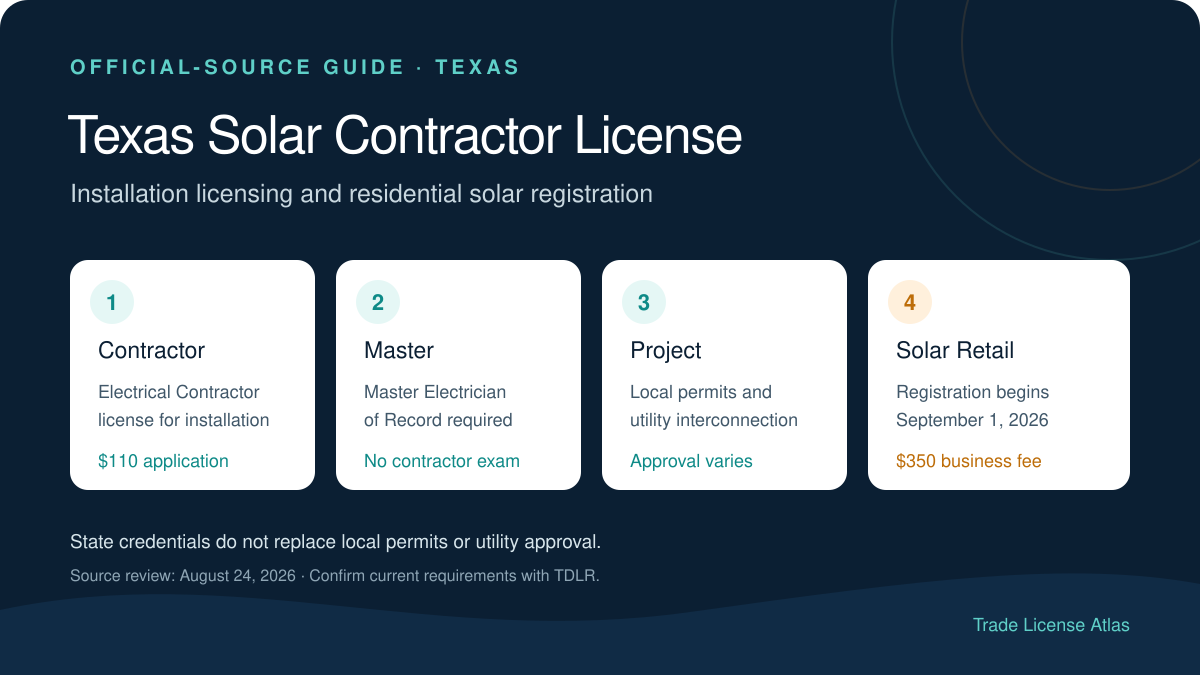
Texas does not issue a credential literally named a Texas solar contractor license. A company that contracts to install photovoltaic wiring and equipment normally needs a Texas Electrical Contractor license, and the people performing the electrical work need the appropriate individual electrician licenses. Residential solar sales can also trigger a separate TDLR registration system beginning September 1, 2026.
Is there a Texas solar contractor license?
No standalone state license uses that exact title. TDLR regulates the electrical installation of solar-energy systems through the Texas Electrical Safety and Licensing Act. Anyone performing non-exempt electrical work must hold the appropriate individual license and perform the work through a licensed Electrical Contractor.
The distinction matters because three different approvals may be involved:
- Electrical Contractor license: allows the business to offer and contract for the electrical installation work.
- Individual electrician license: authorizes each installer to perform work within the scope and supervision rules of that credential.
- Solar Retailer or Salesperson registration: regulates covered residential sales and leases rather than the physical electrical installation.
A local permit and the serving utility’s interconnection approval are project approvals, not substitutes for any required state credential.
Texas solar contractor license requirements at a glance
| Role or approval | When it applies | Main requirement | State fee |
|---|---|---|---|
| Electrical Contractor | Business offers or contracts for solar electrical installation | Master Electrician of Record plus insurance | $110 |
| Individual electrician | Person performs covered solar electrical work | Appropriate apprentice, wireman, journeyman or master license and supervision | Varies by level |
| Residential Solar Retailer | Non-exempt business sells or leases covered residential systems from September 1, 2026 | Registration, responsible party, background review and $1M/$2M insurance | $350 |
| Solar Salesperson | Individual conducts covered residential solar retail for a registered retailer | Registration, retailer employment and background review | $56 |
| Project permit/interconnection | Depends on location, utility and project | Local permit and serving-utility approval | Varies |
The table describes the common routes. An exemption, a non-electrical portion of the project or a different business arrangement can change which credential applies. Confirm the actual work scope before submitting an application.
Electrical Contractor route for solar installation
The normal business credential behind a Texas solar installation company is the Electrical Contractor license. TDLR defines an electrical contractor as a person or business engaged in designing, installing, erecting, repairing or altering electrical wires, conductors, machinery, apparatus or systems used for light, heat, power or signaling.
Master Electrician of Record
The contractor must employ a Texas-licensed Master Electrician and designate that person as its Master Electrician of Record. The master may be the business owner. A Master Electrician is normally assigned to only one Electrical Contractor unless the master owns more than 50 percent of the contracting business.
If the Master Electrician of Record leaves, the contractor must notify TDLR and designate a replacement within 30 business days. The business should therefore treat the designation as an ongoing compliance requirement, not merely an application formality.
Insurance
The Electrical Contractor must file proof of general liability insurance using TDLR’s certificate form. The minimum limits are:
- $300,000 per occurrence for bodily injury and property damage combined.
- $600,000 aggregate for bodily injury and property damage.
- $300,000 aggregate for products and completed operations.
The application also requires proof of workers’ compensation coverage, authority to self-insure or the permitted statement and filing showing that the business elected not to obtain workers’ compensation insurance.
No separate contractor exam
TDLR does not list an examination for the Electrical Contractor business license. The qualifying responsibility sits with the Master Electrician of Record, who must already have met the individual licensing requirements. A new master applicant generally needs 12,000 hours of supervised on-the-job training, at least two years as a Journeyman Electrician and a passing Master Electrician examination.
For the complete individual pathway, read our Texas electrician license guide.
Which licenses do solar installers need?
The company license does not personally license every worker. Each individual performing covered electrical work needs the credential appropriate to the work and supervision arrangement.
- Electrical Apprentice: entry route for work performed under the general supervision allowed by Texas law.
- Residential Wireman: may perform residential electrical installations in single-family and multifamily dwellings not exceeding four stories.
- Journeyman Electrician: performs electrical work under the general supervision of a Master Electrician.
- Master Electrician: may perform the full electrical scope and can serve as the contractor’s Master Electrician of Record.
Roofing, structural, sales and purely administrative activities do not all become electrical work simply because they are part of the same solar project. However, unlicensed workers should not cross into wiring, electrical equipment or other regulated activity. Divide responsibilities according to the actual scope, not a job title such as “solar installer.”
New residential solar retailer registration in 2026
Texas now separately regulates many agreements for the sale or lease of residential solar panels, solar shingles and related systems. TDLR began accepting online registration applications on August 10, 2026. Beginning September 1, 2026, covered residential solar retailers and salespersons must be registered.
Solar Retailer registration
A covered business applies for a Solar Retailer registration with a nonrefundable $350 fee. The registration lasts one year. The business must designate a record keeper or responsible party, report its salespersons, disclose owners and controlling persons, complete the required background-review process and maintain general liability insurance of at least $1 million per occurrence and $2 million aggregate.
Solar Salesperson registration
An individual performing covered residential solar retail applies with a nonrefundable $56 fee and must work for a registered Solar Retailer. TDLR lists no experience or examination requirement, but the applicant must pass the required criminal-history background review. The registration lasts one year.
Electrical-contractor exemption
Texas-licensed Electrical Contractors and their employees are exempt from the separate Solar Retailer and Solar Salesperson registration and insurance requirements when they engage in residential solar retail. They remain subject to most provisions governing residential solar transactions, including applicable contract, cancellation, supervision and consumer-protection duties.
The exemption does not remove the Electrical Contractor licensing, insurance or individual-electrician rules governing the installation itself.
How to get a Texas solar contractor license
- Define the business model. Decide whether the company will install systems, sell or lease residential systems, or do both.
- Choose the correct state route. Installation businesses normally use the Electrical Contractor route. A non-exempt sales business may need Solar Retailer registration.
- Secure the qualifying person. The Electrical Contractor applicant must employ a Texas-licensed Master Electrician of Record.
- Arrange insurance. Obtain the coverage required for the selected credential and ensure the business name matches the application and certificate.
- Submit the TDLR application and fee. Use the current official form or online licensing system for the credential.
- License the workforce. Confirm that everyone performing electrical work holds the appropriate individual credential and receives the required supervision.
- Check local requirements. Identify the authority having jurisdiction and obtain building, electrical or structural permits required for each project.
- Obtain interconnection approval. Follow the serving utility, electric cooperative or municipally owned utility process before operating a grid-connected system.
- Maintain records and renew. Track license expiration, insurance, responsible-party information, workforce credentials and project approvals.
Use the Trade License Atlas License Finder when comparing another occupation or destination state.
Texas solar contractor license cost
| Item | Current state amount | Notes |
|---|---|---|
| Electrical Contractor application | $110 | Nonrefundable; insurance and Master Electrician of Record required |
| Electrical Contractor renewal | $110 | Annual, when renewed on time |
| Solar Retailer registration | $350 | Nonrefundable; annual registration |
| Solar Salesperson registration | $56 | Nonrefundable; annual registration |
| Local permits | Varies | Set by the authority having jurisdiction |
| Utility interconnection | Varies | Process and charges depend on the serving utility |
The state fee is only one part of the cost. Insurance premiums, business formation, individual electrician licensing, examinations, continuing education, local permits, engineering, equipment and utility requirements are separate.
Local permits and utility interconnection
A state Electrical Contractor license does not eliminate project-level approval. Texas residential solar agreements must provide for obtaining any permit required by a government entity and, when applicable, the serving utility’s approval to interconnect the system.
Before pricing a project, identify:
- The city, county or other authority that issues electrical and building permits.
- The adopted electrical code and any plan-review requirements.
- Structural or fire-access documentation required for the roof or array.
- The serving utility’s application, technical documentation and inspection sequence.
- Whether permission to operate is required after installation and inspection.
Do not assume that approval in one Texas city or utility territory carries into another. A company can hold the correct statewide license and still lack permission to begin or energize a particular project.
Texas solar contractor license renewal and continuing education
The Texas Electrical Contractor license is valid for one year and currently renews for $110. The contractor must keep the required liability insurance and Master Electrician of Record designation in place.
The contractor business license itself is not subject to the electrician continuing-education requirement. Individual electrician licensees generally need four hours of TDLR-approved continuing education during each annual license term. The course must address the National Electrical Code, Texas electrical law and rules, and electrical safety.
Solar Retailer and Solar Salesperson registrations are also valid for one year. Update responsible-party, salesperson, owner or controlling-person information when required rather than waiting until renewal.
Out-of-state Texas solar contractor license applicants
Texas does not provide automatic transfer of an out-of-state solar-company credential into an Electrical Contractor license. The Texas business must satisfy the state contractor requirements, including the Master Electrician of Record and insurance conditions.
Texas has limited reciprocity arrangements for certain individual electrician licenses, but the agreement, license level and applicant history must match. Reciprocity for an individual electrician does not itself authorize a business to contract for Texas solar projects.
Check our license reciprocity guide and obtain TDLR confirmation before relying on an out-of-state credential.
Texas solar contractor license application checklist
- Installation, retail-sales and project-approval roles separated.
- Texas Electrical Contractor application completed when installation contracting is offered.
- Texas-licensed Master Electrician of Record designated.
- Electrical Contractor liability-insurance certificate prepared.
- Workers’ compensation proof, self-insurance authority or permitted no-coverage documentation prepared.
- $110 contractor application fee submitted.
- Individual installer licenses and supervision verified.
- Solar Retailer and Salesperson registrations assessed for covered residential sales.
- Local permit authority identified for each project.
- Serving utility’s interconnection process confirmed.
- Residential contract and cancellation requirements incorporated.
Frequently asked questions
Does Texas have a solar contractor license?
Not under that exact name. A business offering solar electrical installation normally needs a Texas Electrical Contractor license, while individual installers need the appropriate electrician licenses.
Do I need a Master Electrician for a solar company in Texas?
Yes, if the company is applying for the Electrical Contractor license used to offer or contract for the electrical installation. The business must employ a Texas-licensed Master Electrician of Record.
Is there a Texas solar contractor exam?
TDLR does not list a separate examination for the Electrical Contractor business license. The designated Master Electrician must already satisfy the individual experience and examination rules.
How much is a Texas solar contractor license?
The Electrical Contractor application fee is $110. Insurance, individual licenses, local permits and utility charges are additional. A non-exempt Solar Retailer registration costs $350 and a Solar Salesperson registration costs $56.
Who needs the new Solar Retailer registration?
Beginning September 1, 2026, a non-exempt business selling or leasing covered residential solar systems must hold the registration. Texas-licensed Electrical Contractors and their employees have a statutory exemption from the separate retail registrations but still must follow applicable transaction rules.
Can an unlicensed employee install solar panels?
An employee may perform non-electrical tasks within the lawful scope of the job, but covered electrical work requires the appropriate Texas electrician credential and supervision. An unlicensed job title does not override the electrical licensing law.
Does a state license replace city permits?
No. Local building, electrical or structural permits may still apply, and grid-connected projects normally require approval from the serving utility, cooperative or municipally owned utility.
Is NABCEP certification required in Texas?
TDLR does not list NABCEP certification as a substitute for the Texas Electrical Contractor or individual electrician licenses. A customer, employer, lender or program may value a private certification separately.
How often does the license renew?
The Electrical Contractor license renews annually. Solar Retailer and Solar Salesperson registrations are also issued for one-year terms.
Official sources used
- TDLR Electricians program and statewide licensing rule
- TDLR Electrical Contractor application, insurance and fee requirements
- TDLR Electrical Contractor renewal requirements
- TDLR Master Electrician qualifications
- Texas electrical laws and administrative rules
- TDLR Residential Solar Retailers program
- TDLR Solar Retailer registration and insurance requirements
- TDLR Solar Salesperson registration requirements
- TDLR residential solar implementation dates and contract duties
- Residential Solar Retailer Regulatory Act and Chapter 71 rules
- TDLR August 2026 program and enforcement update
Verified licensing details
- Licensing authority
- Texas Department of Licensing and Regulation (TDLR)
- Fees
- A Texas Electrical Contractor license costs $110 initially and $110 to renew annually. Beginning September 1, 2026, a non-exempt residential Solar Retailer registration costs $350 and an individual Solar Salesperson registration costs $56. Local permits and utility charges are separate.
- Experience
- The business contractor license has no separate experience-hour requirement, but the business must employ a Texas-licensed Master Electrician of Record. A Master Electrician generally needs 12,000 hours of supervised training and at least two years holding a Journeyman Electrician license.
- Exams
- TDLR does not list a separate Electrical Contractor examination. The designated Master Electrician must meet the individual experience and examination requirements. Solar Retailer and Solar Salesperson registrations do not require an examination.
- Insurance or bond
- An Electrical Contractor must maintain at least $300,000 per occurrence, $600,000 aggregate and $300,000 products/completed-operations aggregate liability coverage. A non-exempt residential Solar Retailer needs at least $1 million per occurrence and $2 million aggregate liability coverage.
- Continuing education
- TDLR does not impose electrician continuing education on the Electrical Contractor business license itself. Licensed electricians, including the Master Electrician of Record, generally complete four hours of approved continuing education for each annual renewal.
- Renewal period
- Electrical Contractor, Solar Retailer and Solar Salesperson credentials renew annually. The current Electrical Contractor renewal fee is $110.
Official sources
Official sources last checked August 23, 2026.
Requirements can change and local rules may apply. Confirm the current requirements with the official authority before paying a fee or beginning work.