
Official-source review: August 24, 2026
A Texas septic installer license is officially an On-Site Sewage Facility, or OSSF, Installer license. The Texas Commission on Environmental Quality issues Installer I and Installer II licenses, while counties, cities, public-health districts and other authorized agents commonly administer permits for individual septic projects.
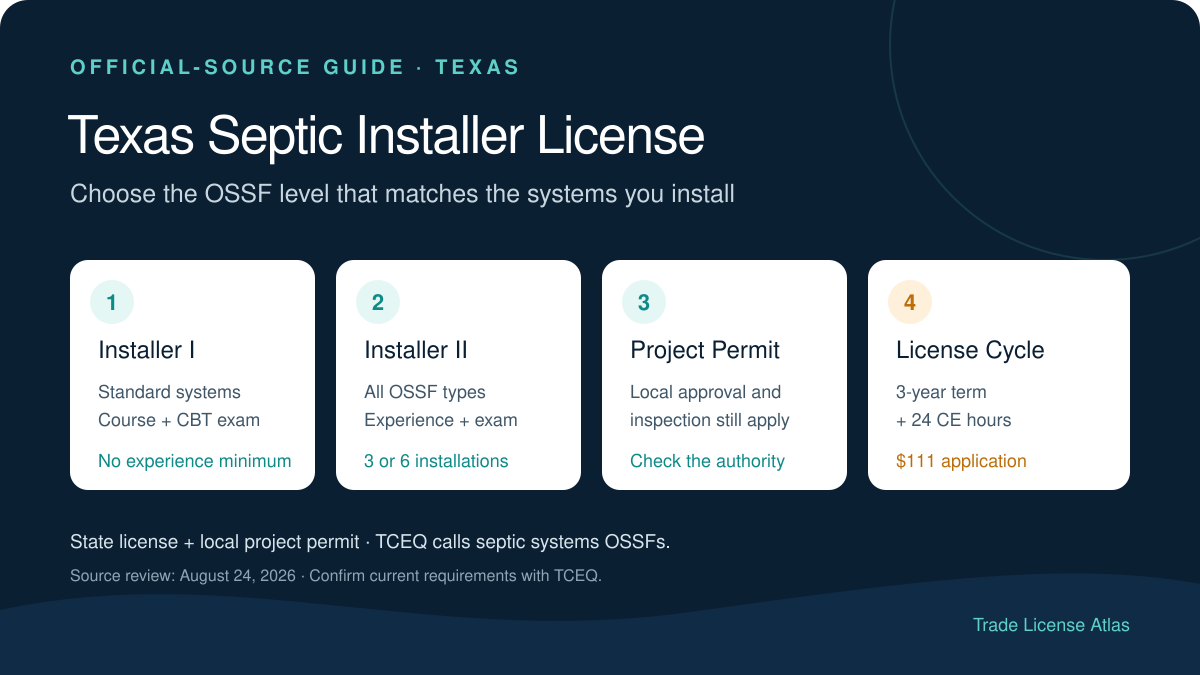
Texas septic installer license requirements at a glance
| Credential | Main qualification | Authorized work | TCEQ fee |
|---|---|---|---|
| OSSF Apprentice | No initial education, experience, course or exam | Installation services under constant, direct supervision | $111 |
| Installer I | Installer I Basic Training plus approved CBT application | Standard OSSF systems listed by TCEQ | $111 |
| Installer II | Installer II training, qualifying license or registration history, documented installations and CBT | All types of OSSF systems | $111 |
There is no minimum education or prior work-experience requirement for Installer I. This makes it the direct entry-level license for a person ready to complete the approved course and pass the state examination. Apprentice registration is useful for supervised field experience, particularly for someone planning to qualify directly for Installer II.
The Texas septic installer license does not itself approve a particular installation. Nearly every new construction, alteration, extension or repair also needs a project permit and approved planning materials from the authority serving that location.
Installer I vs. Installer II
OSSF Installer I
Installer I may install the standard systems identified by TCEQ: septic tanks, absorptive drainfields, unlined evapotranspiration drainfields, leaching chambers, gravel-less pipe and pumped-effluent drainfields. The license is appropriate when the contractor’s work stays within those system types.
An Installer I applicant completes the approved Installer I Basic Training course before applying. After TCEQ approves the Texas septic installer license application, the candidate registers for the OSSF Installer I computer-based test.
OSSF Installer II
Installer II may install all types of on-site sewage facilities. That broader scope matters for alternative or more complex treatment and disposal systems that fall outside the Installer I list.
There are two published experience routes. A current Installer I may qualify after holding that license for at least one year and verifying at least three installations. Alternatively, a registered Apprentice may qualify after holding the registration for at least two years and verifying at least six installations.
Texas OSSF Apprentice registration
An Apprentice does not need prior education, work experience, an initial training course or a licensing examination. The applicant submits the TCEQ application and $111 fee. Registration is not the same as an unrestricted Texas septic installer license.
The apprentice may represent the supervising installer at the job site and perform installation services only under constant, direct supervision. That supervision may be onsite or maintained through radio or another direct communication method. When the supervisor is not onsite, the licensed installer must visit the project at least once each workday and verify compliance with state and authorized-agent requirements.
This route can build the two years and six documented installations needed for Installer II. Someone who wants only the standard-system scope may instead complete Installer I training and pursue that license without a preliminary experience period.
How to get a Texas septic installer license
- Select the correct level. Choose Installer I for the standard systems listed by TCEQ or Installer II for authority covering all OSSF types.
- Complete the approved initial course. Installer I uses course code 417; Installer II uses course code 418. Verify the provider in TCEQ’s current training search.
- Prepare experience documents for Installer II. Use the applicable sworn-statement form and collect every required signature before submission.
- Apply through TCEQ. Use the Occupational Licensing Electronic Application and upload course records, experience evidence and other requested documents.
- Pay the $111 application fee. TCEQ identifies application fees as nonrefundable and nontransferable.
- Resolve any deficiency promptly. TCEQ states that unresolved deficiencies can cause an application to expire after 120 days from notification.
- Wait for application approval. Installer candidates register for the computer-based test only after TCEQ approves eligibility.
- Pass the exam for the selected level. Follow the current testing instructions and retain the result documentation.
- Check every project jurisdiction. Find the local permitting authority and obtain the required OSSF permit and plan approval before installation begins.
Use the license finder if the job also involves regulated plumbing, electrical, water-well or backflow work. One occupational credential should never be assumed to replace another program’s license.
Required training and licensing examination
Installer I applicants complete the TCEQ-approved Installer I course, currently identified as course code 417. Installer II applicants complete the approved Installer II course, code 418. The course must be finished before submitting the license application.
Once approved, the applicant registers for the corresponding OSSF computer-based test. The official testing page lists separate Installer I and Installer II examinations. Testing-center charges, appointment rules, identification requirements and available dates can change, so confirm them during registration rather than relying on an old third-party fee list.
Study should match the selected level. Core subjects include Texas OSSF rules, site and system concepts, installation standards, construction practices, inspections, safety and the limits of each credential. Installer II preparation must address the broader range of systems permitted under that license.
Application fee and realistic total cost
| Cost item | Current amount or treatment |
|---|---|
| Installer I application | $111 |
| Installer II application | $111 |
| Apprentice registration | $111 |
| Approved initial course | Provider price varies |
| Computer-based examination | Testing charge confirmed during registration |
| Normal individual renewal | $111 |
| Local OSSF project permit | Varies by permitting authority and project |
The $111 state fee is only one part of the budget. Applicants should include training, examination, travel, reference material and possible retesting. A working business may also need equipment, vehicles, general liability coverage, workers’ compensation arrangements and local registrations even though TCEQ does not list a standard bond or insurance filing for the individual Installer I or II application.
OSSF permits, inspections and local rules
A state Texas septic installer license and a project permit solve different problems. The Texas septic installer license confirms the individual’s occupational authority. The permit approves the planned system for a particular property.
TCEQ says a permit and approved planning materials are generally required to construct, install, alter, extend or repair an OSSF. The application goes to the local permitting authority. If no local government has assumed the program, the appropriate TCEQ regional office acts as the authority.
Local programs may be more stringent than the statewide minimum rules. The installer should verify design approval, site evaluation, setbacks, inspection stages, authorization to construct and final approval before covering components or placing the system into service.
Does the 10-acre rule eliminate licensing?
No blanket assumption is safe. TCEQ describes a narrow possible permit exemption for a single-family dwelling on a tract of at least 10 acres when all listed conditions are satisfied, including a qualifying site evaluation, 100-foot property-line separation, onsite effluent disposal and no nuisance or groundwater pollution. Local requirements still must be checked.
Can a homeowner install a septic system?
A limited owner installation may be allowed when the system serves the owner’s single-family dwelling on property the person owns, no part is being developed for sale or lease, the owner has the necessary skills and equipment, and every permitting and construction requirement is met. The local authority can restrict that option.
If another person assists with work such as trenching or backhoe operation, TCEQ says that worker generally needs the correct installer license. Narrow exceptions include a licensed electrician handling electrical components and a person who only delivers and sets a treatment or pump tank into the excavation.
Related OSSF licenses are not interchangeable
Texas regulates several distinct roles around septic systems. A Site Evaluator performs the preconstruction evaluation and identifies site features that affect suitability. A Designated Representative works for an authorized agent and performs regulatory functions such as inspections and complaint investigations. Neither role is replaced by a Texas septic installer license.
A Maintenance Provider services or maintains systems using aerobic treatment, while a registered Maintenance Technician works under a provider’s direct supervision. An Installer II license is one possible qualification for becoming a Site Evaluator or Maintenance Provider, but it does not automatically issue either credential.
Pumping and transporting septic waste is another regulatory activity and should not be confused with installing an OSSF. Define the actual service offered before selecting licenses, registrations and business requirements. Browse the trade directory or state directory to compare other regulated occupations.
Three-year renewal and continuing education
Installer I and Installer II licenses are valid for three years. Renewal requires 24 hours of TCEQ-approved continuing education completed before expiration, a renewal application, criminal-history attestation and the applicable fee. The normal individual renewal processing fee is currently $111.
Apprentice registrations are also issued on a three-year cycle but are excluded from the OSSF continuing-education requirement identified by TCEQ. Confirm the status and expiration date through the agency’s license search rather than estimating from the original application date.
Effective for licenses expiring on or after September 1, 2025, TCEQ accepts late renewal applications for up to 180 days with additional fees. Applications submitted 1–90 days late cost 1.5 times the normal amount; applications 91–180 days late cost twice the normal amount. A person who has applied within the first 90 days may continue regulated activities while the renewal is pending, but someone who has not applied may not work after expiration.
After 180 days, the credential cannot be renewed. The former licensee must meet the current new-license requirements and pass the applicable examination again.
Out-of-state license and reciprocity
TCEQ may waive qualifications, training or an examination for an out-of-state license on a case-by-case basis; it is not automatic reciprocity. The applicant needs a current license issued through an examination, good compliance history and good standing with the issuing authority.
The reciprocity request is made through the electronic application, includes the $111 fee, and requires a copy of the current license plus applicable training certificates. TCEQ contacts the other authority and determines which Texas level, if any, is comparable.
Use our license reciprocity checker for orientation, but wait for TCEQ’s written decision before offering work in Texas.
Application checklist
- Installer I, Installer II or Apprentice route selected.
- TCEQ-approved initial course completed for Installer I or II.
- Installer II license or Apprentice history meets the applicable time requirement.
- Three or six qualifying installations documented on the correct sworn statements.
- Electronic application completed accurately.
- $111 nonrefundable application fee submitted.
- Criminal-history documentation included when required.
- TCEQ eligibility approval received before exam registration.
- Computer-based licensing exam passed.
- Local permitting authority and project requirements identified.
Frequently asked questions
What is the official name of the Texas septic installer license?
TCEQ calls it an On-Site Sewage Facility Installer license. The two levels are OSSF Installer I and OSSF Installer II.
Do I need experience for Installer I?
No minimum education or work experience is listed. You must complete Installer I Basic Training, apply with the $111 fee, receive approval and pass the Installer I computer-based exam.
How do I qualify for Installer II?
Hold Installer I for at least one year and document three installations, or hold an Apprentice registration for at least two years and document six installations. Complete Installer II training and pass its exam.
What systems can Installer I install?
TCEQ lists septic tanks, absorptive drainfields, unlined ET drainfields, leaching chambers, gravel-less pipe and pumped-effluent drainfields. Installer II may install all OSSF types.
How much does a Texas septic installer license cost?
The current TCEQ application fee is $111. Training, computer-based testing, local permits, insurance and business costs are separate.
How long is the license valid?
Three years. Installer I and Installer II renewals require 24 hours of approved continuing education.
Can an apprentice work alone?
No. An apprentice works under constant, direct supervision. Communication may be remote, but when the supervisor is not onsite the licensed installer must visit at least once every workday.
Does the installer license replace a septic permit?
No. Most construction, installation, alteration, extension and repair projects need a permit and approved planning materials from the local authority or TCEQ regional office.
Can an out-of-state license transfer automatically?
No. TCEQ evaluates reciprocity individually and may waive some requirements only after reviewing the license, examination history, training and standing.
Official sources used
- TCEQ OSSF license and registration requirements
- TCEQ approved initial and renewal training requirements
- TCEQ new occupational-license applications
- TCEQ electronic application instructions
- TCEQ computer-based occupational examinations
- TCEQ renewal requirements by license type
- TCEQ late-renewal rules and fees
- TCEQ out-of-state reciprocity evaluation
- TCEQ OSSF project permits and homeowner-installation rules
- TCEQ general OSSF information and license verification
- Texas Administrative Code Chapter 285 OSSF rules
Verified licensing details
- Licensing authority
- Texas Commission on Environmental Quality (TCEQ)
- Fees
- The current TCEQ application fee is $111 for an OSSF Installer I license, Installer II license or Apprentice registration. Required training, computer-based testing and local project-permit costs are separate.
- Experience
- Installer I has no minimum education or work-experience requirement. Installer II applicants may qualify after holding Installer I for at least one year and documenting three installations, or after holding an Apprentice registration for at least two years and documenting six installations.
- Exams
- Installer I and Installer II applicants complete the approved course for their level, submit the TCEQ application and receive approval before registering for the applicable computer-based licensing examination. Apprentice registration does not require an initial course or exam.
- Insurance or bond
- TCEQ does not list a general bond or liability-insurance certificate among the standard individual Installer I or Installer II application requirements. Employers, contracts, local permitting authorities and business structures may impose separate requirements.
- Continuing education
- Installer I and Installer II licensees need 24 hours of TCEQ-approved continuing education during each three-year cycle. Apprentice registrations are excluded from the OSSF continuing-education requirement.
- Renewal period
- Three years. The normal individual renewal processing fee is currently $111 when submitted on time; higher fees apply during the late-renewal windows.
Official sources
Official sources last checked August 23, 2026.
Requirements can change and local rules may apply. Confirm the current requirements with the official authority before paying a fee or beginning work.