
Official-source review: August 27, 2026
Ohio water well contractor registration: Ohio requires private water systems contractors to register annually with the Department of Health. The scope includes drilling wells, installing pumps, repairing or sealing private water systems and performing paid inspections or sampling. Local boards of health issue permits and inspect the work.
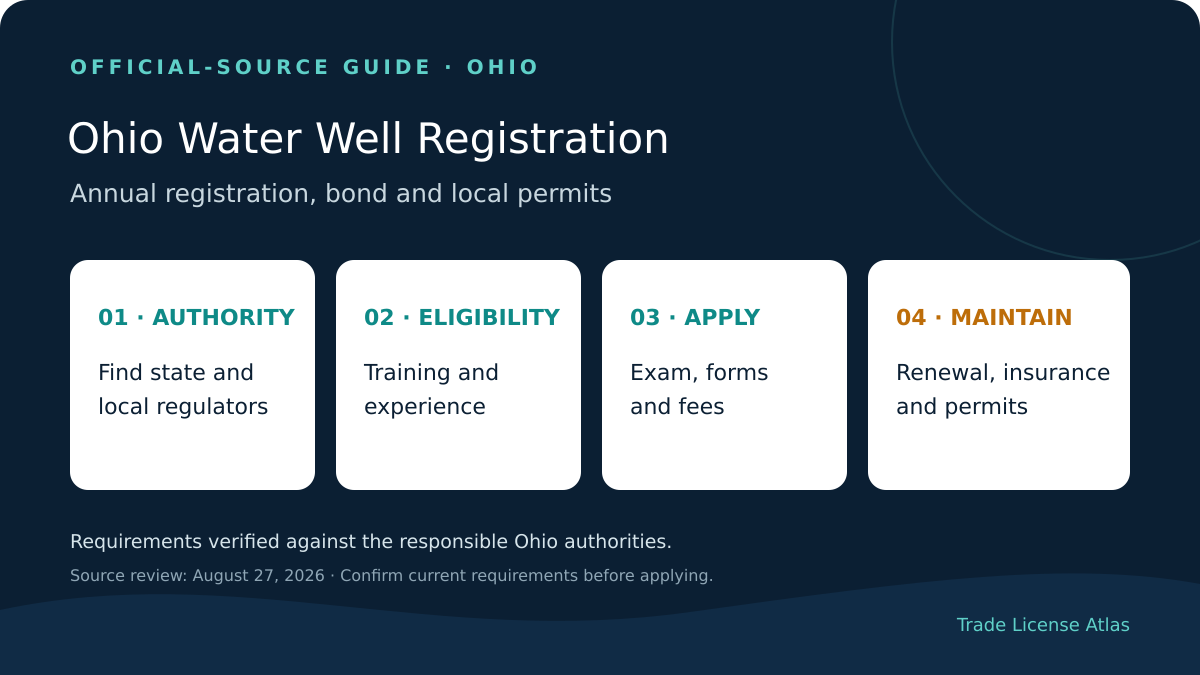
What the Ohio water well contractor registration covers
Ohio requires private water systems contractors to register annually with the Department of Health. The scope includes drilling wells, installing pumps, repairing or sealing private water systems and performing paid inspections or sampling. Local boards of health issue permits and inspect the work.
- Construction, alteration, service, repair, sealing and paid evaluation of private water systems.
- Work only within the issued credential scope.
- Obtain all local permits and inspections.
Compare related occupations and states in the License Finder.
Ohio water well contractor registration requirements at a glance
| Requirement | Current rule or route |
|---|---|
| Route | Ohio Department of Health annual Private Water Systems Contractor registration plus local health-district permits |
| Eligibility | No universal hour threshold is stated; comply with registration evidence, approved competency or continuing education and first-year assessment inspection requirements. |
| Exam | No general initial written state examination is stated; new registrants undergo the required construction and knowledge assessment inspection. |
| Fees | The rule lists $250 for a timely contractor registration, $500 after covered work has already occurred and $65 for qualifying owner-only registration. |
| Bond or insurance | At least $500,000 general liability plus a $10,000 annual bond; new, previously suspended or qualifying claim-history applicants use a $20,000 bond for the prescribed period. |
| Renewal | Annual; registration expires December 31. |
Do not treat this table as an approval notice. The agency, certification organization or local jurisdiction makes the final eligibility decision and may request additional evidence.
How to complete the Ohio water well contractor registration process
- Identify the exact state and local credential required.
- Complete the published education and experience.
- Pass each required examination.
- Submit applications, identity records and fees.
- Complete business, insurance and employment filings.
- Obtain project permits and renew on time.
Keep copies of every experience certificate, examination result, bond or insurance filing and payment receipt. Names and business entities should match across the application and supporting documents.
Important Ohio rules and boundaries
- Employees under direct supervision are not separately registered.
- Local private-well permits and inspections remain required.
- Well drilling and other private-water-system work share the registration but must follow specific construction rules.
- Owner exemptions are narrow and do not authorize general contracting.
Ohio may separate the credential held by a worker from the contractor license held by the business, while preserving local authority over permits and inspections. Confirm every applicable layer before bidding, advertising or beginning regulated work.
Ohio water well contractor registration cost and renewal
Budget separately for education, examinations, state and local credentials, insurance and project permits.
Renew each state and local credential separately and verify current charges before filing.
Government charges are only part of the expected cost. Training, examination preparation, fingerprints, surety premiums, insurance, equipment calibration and local permits can add to the total.
Ohio water well contractor registration checklist
- Confirm that this credential matches the exact work you will perform.
- Check whether the applicant is an individual, sole owner or separate business entity.
- Collect experience and training records before submitting the application.
- Use the current official form and fee schedule.
- Complete every required examination or approved certification route.
- File bonds, insurance and fingerprints when applicable.
- Check county, city, water supplier and building-permit rules.
- Save the expiration date and renewal requirements.
Frequently asked questions
Is this credential statewide?
It depends on the occupation and scope. Ohio licenses several commercial contractor trades statewide and leaves other worker or residential credentials to local authorities.
Is an exam required?
No general initial written state examination is stated; new registrants undergo the required construction and knowledge assessment inspection.
When does it renew?
Annual; registration expires December 31.
Are local approvals separate?
Yes.
Official sources used
- Contractor registration and bonding rule
- Private water systems rules
- New-contractor assessment inspection
- Ohio Revised Code authority
Verified licensing details
- Jurisdiction
- state license, state certificate or local credential, depending on the occupation and project
- Licensing authority
- Ohio Department of Health and local board of health
- Fees
- The rule lists $250 for a timely contractor registration, $500 after covered work has already occurred and $65 for qualifying owner-only registration.
- Experience
- No universal hour threshold is stated; comply with registration evidence, approved competency or continuing education and first-year assessment inspection requirements.
- Exams
- No general initial written state examination is stated; new registrants undergo the required construction and knowledge assessment inspection.
- Insurance or bond
- At least $500,000 general liability plus a $10,000 annual bond; new, previously suspended or qualifying claim-history applicants use a $20,000 bond for the prescribed period.
- Continuing education
- Renewing contractors complete at least six approved hours during the prior year or document an accepted operator, water-quality or groundwater certification.
- Renewal period
- Annual; registration expires December 31.
Official sources
Official sources last checked August 26, 2026.
Requirements can change and local rules may apply. Confirm the current requirements with the official authority before paying a fee or beginning work.