
Official-source review: August 25, 2026
Florida backflow tester certification: Florida DEP requires each community water system to define tester qualifications and procedures in its cross-connection-control plan. Certification training is commonly obtained through an accepted backflow program, but the tester must also satisfy the specific water supplier’s registration, reporting and gauge-calibration rules.
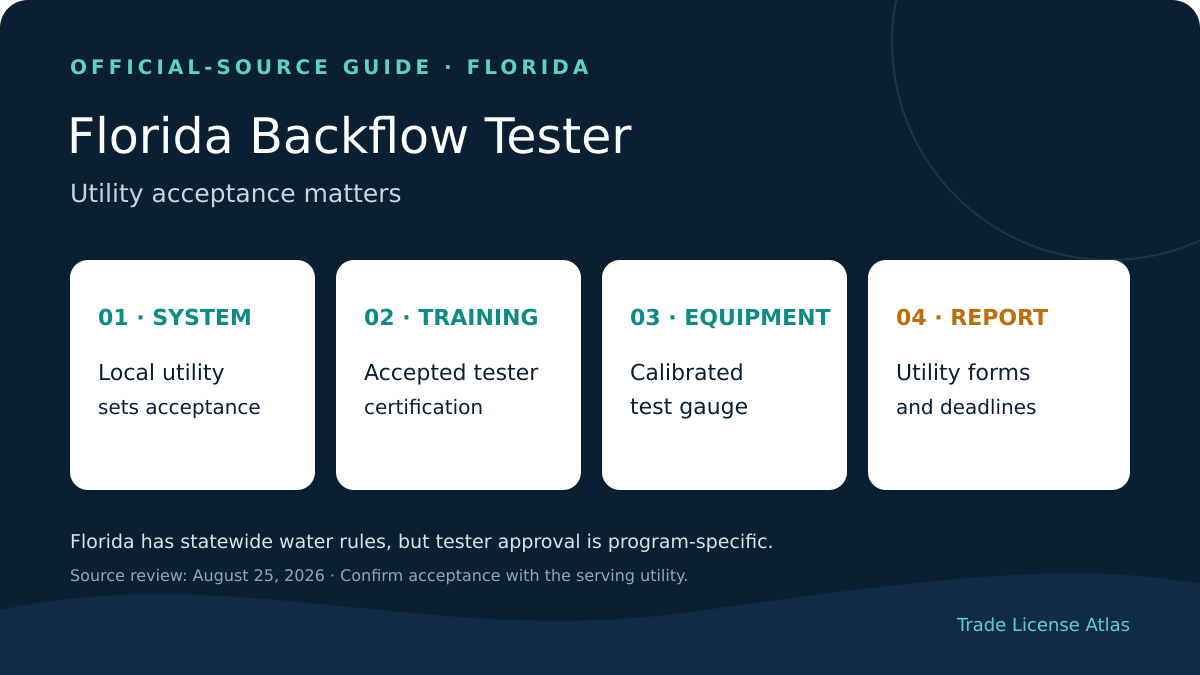
What the Florida backflow tester certification covers
The practical market is utility-by-utility. Rule 62-555.360 requires the public water system to state tester qualifications, procedures and frequency, so successful testers verify acceptance before taking a job.
- Field testing of approved backflow prevention assemblies.
- Use of properly calibrated differential-pressure gauge equipment.
- Reporting results through the water supplier’s required system.
- Testing after installation or repair and at the supplier’s required interval.
- Maintaining accepted certification and local tester registration.
Installation and repair work can require the Florida plumbing contractor license.
Florida backflow tester certification requirements at a glance
| Requirement | Current rule or route |
|---|---|
| State framework | DEP Rule 62-555.360 |
| Tester qualification | Defined by each public water system |
| Certification | Accepted backflow tester program |
| Equipment | Properly calibrated gauge |
| Local registration | Often required |
| Reporting | Utility-specific portal/form |
| Fees/renewal | Vary |
Do not treat this table as an approval notice. The agency, certification organization or local jurisdiction makes the final eligibility decision and may request additional evidence.
How to complete the Florida backflow tester certification process
- Choose a certification accepted by the utilities you intend to serve.
- Complete the course and written/practical assessment.
- Obtain and calibrate the required test kit.
- Submit certificate and calibration records to each utility.
- Test assemblies using the required procedure.
- File the report through the utility’s portal and renew before expiration.
Keep copies of every experience certificate, examination result, bond or insurance filing and payment receipt. Names and business entities should match across the application and supporting documents.
Important Florida rules and boundaries
- DEP establishes the water-system program duty but does not publish one universal tester license for every utility.
- A valid certificate may still require local registration.
- Testing does not by itself authorize plumbing installation or repair.
- Nonresidential assemblies required by the rule are tested after installation/repair and at least annually; residential frequency can differ.
Florida may separate the credential held by a worker from the contractor license held by the business, while preserving local authority over permits and inspections. Confirm every applicable layer before bidding, advertising or beginning regulated work.
Florida backflow tester certification cost and renewal
Budget for initial training and testing, recertification, a differential-pressure test kit, annual calibration and any utility or reporting-platform charges.
Track both the certification expiration and each utility registration. Submit updated certificates and calibration documents wherever required.
Government charges are only part of the expected cost. Training, examination preparation, fingerprints, surety premiums, insurance, equipment calibration and local permits can add to the total.
Florida backflow tester certification checklist
- Confirm that this credential matches the exact work you will perform.
- Check whether the applicant is an individual, sole owner or separate business entity.
- Collect experience and training records before submitting the application.
- Use the current official form and fee schedule.
- Complete every required examination or approved certification route.
- File bonds, insurance and fingerprints when applicable.
- Check county, city, water supplier and building-permit rules.
- Save the expiration date and renewal requirements.
Frequently asked questions
Is there one Florida state tester license?
No single universal tester card controls every utility; public water systems define accepted qualifications under the DEP rule.
Do utilities require separate registration?
Many do. Confirm before submitting tests.
Must gauges be calibrated?
DEP explains mechanical assemblies must be tested with properly calibrated gauge equipment.
Can tester certification replace a plumbing license?
No. Installation and repair can require separate contractor authority.
Official sources used
- Florida DEP cross-connection and backflow program
- Florida Administrative Code Rule 62-555.360
- Lee County Utilities tester/reporting example
- Panama City tester registration example
Verified licensing details
- Licensing authority
- Florida Department of Environmental Protection and local public water system
- Fees
- No single statewide fee; course, examination, recertification, gauge calibration and utility registration costs vary.
- Experience
- Set by the accepted certification program and local utility.
- Exams
- Written and hands-on testing through the selected certification program.
- Insurance or bond
- Utility or employer may require business licensing and insurance; calibrated test equipment is essential.
- Continuing education
- Recertification rules depend on the certificate and utility acceptance program.
- Renewal period
- Certification and local tester registrations follow their issuing program’s cycle.
Official sources
Official sources last checked August 24, 2026.
Requirements can change and local rules may apply. Confirm the current requirements with the official authority before paying a fee or beginning work.