
Initial source review: August 24, 2026
Selected sections updated: October 12, 2026. See the checked scope and practical examples.
A California HVAC contractor license is the C-20 Warm-Air Heating, Ventilating and Air-Conditioning classification issued by the Contractors State License Board. It allows the licensed business to contract for qualifying heating, ventilation and air-conditioning systems. Technicians who handle regulated refrigerants also need the appropriate federal EPA Section 608 certification.
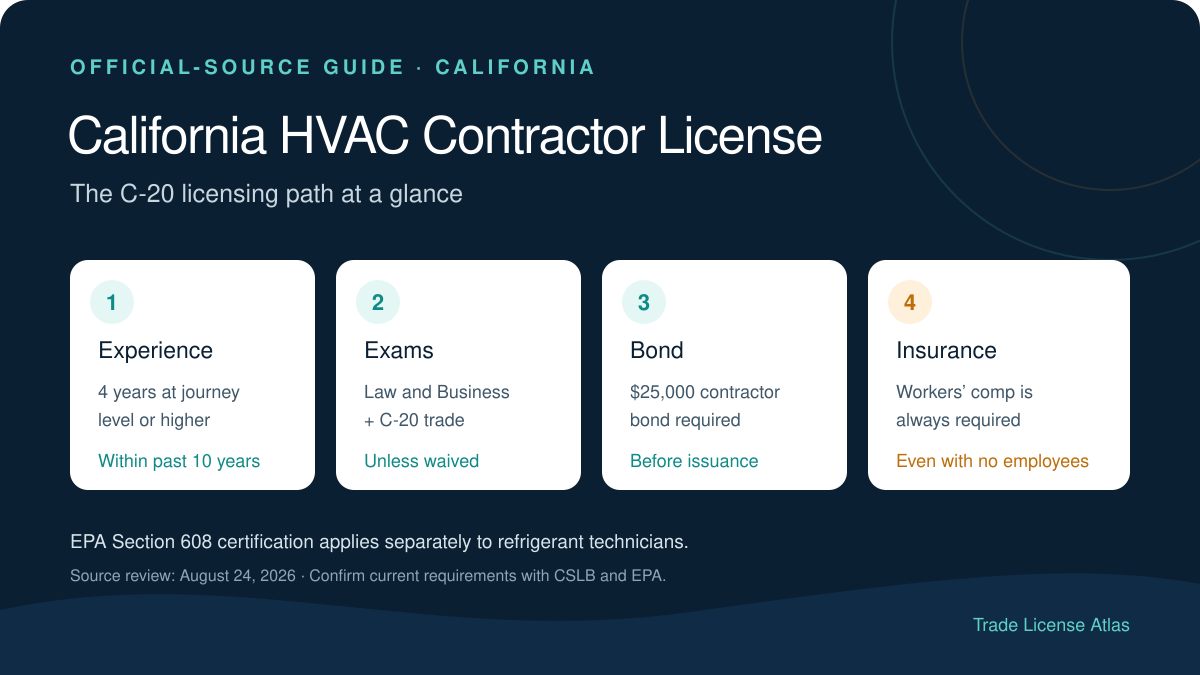
What does the California C-20 HVAC license cover?
The official classification is C-20 Warm-Air Heating, Ventilating and Air-Conditioning Contractor. Its scope includes fabricating, installing, maintaining, servicing and repairing:
- Warm-air heating systems and associated appliances.
- Water-heating heat pumps.
- Ventilation systems, blowers and plenum chambers.
- Air-conditioning systems and air-conditioning units.
- Ducts, registers, flues, humidity controls, thermostatic controls and air filters connected to those systems.
- Warm-air heating, ventilation and air-conditioning systems that use solar energy.
The C-20 classification is different from California’s C-38 Refrigeration Contractor classification, C-4 Boiler classification and C-10 Electrical classification. A project crossing several scopes may require another classification or properly licensed subcontractor. For electrical licensing, see our California electrician license guide.
California HVAC contractor license requirements at a glance
| Requirement | C-20 rule or common route |
|---|---|
| Minimum age | At least 18 for the qualifying individual |
| Experience | Four years at journey level or higher within the prior ten years |
| State exams | Law and Business plus C-20 trade exam, unless formally waived |
| Application fee | $450 |
| Initial license fee | $200 sole owner; $350 non-sole owner |
| Contractor bond | $25,000 |
| Workers’ compensation | Mandatory for active C-20 licenses, including no-employee businesses |
| Refrigerant credential | EPA Section 608 certification for technicians opening covered refrigerant circuits |
| License term | Two years for an active license |
A local business license or EPA card does not replace the C-20 contractor license. Conversely, the C-20 license does not replace individual federal refrigerant certification or project permits.
Four-year experience requirement
The person qualifying the C-20 classification generally needs at least four years of experience at journey level or above during the ten years immediately before applying. CSLB recognizes experience as a journeyperson, foreperson, supervising employee, contractor or owner-builder when properly documented.
Journey-level experience means the person can perform the trade without supervision. Time spent only as a trainee or helper does not automatically count at that level. Education or apprenticeship training may provide limited credit under CSLB rules, but at least one year of practical experience ordinarily remains necessary.
The application uses a Certificate of Work Experience completed by a person with direct knowledge of the applicant’s work. The description should show the actual C-20 duties performed rather than merely state “HVAC work.” CSLB may request further documentation or investigate experience claims.
Prepare a C-20 application that documents the work
Targeted source check: October 12, 2026. This update covers experience evidence, the application budget, workers’ compensation filing, federal technician certification and where to check an out-of-state examination waiver.
CSLB evaluates the qualifying individual’s experience, not simply how long the company has traded. A description such as “HVAC technician for four years” does not show when the person worked at journey level or which C-20 duties they performed.
Hypothetical preparation example: a technician spent two years as a supervised helper and then three years performing the trade without supervision. Do not present that as five years of journey-level experience. Separate the periods, identify any education credit being claimed and let CSLB decide whether the combined evidence satisfies the requirement.
- List the work periods: record dates, employers, role, duties and whether work was full-time or part-time. Explain tasks such as duct installation, system startup, maintenance and repair only when they reflect the work actually performed.
- Choose an appropriate certifier: CSLB requires firsthand knowledge of the claimed experience. Confirm that the person observed your work before asking them to sign the experience certification.
- Retain supporting records: use CSLB’s acceptable supporting documentation list for evidence appropriate to the work arrangement. A signed certificate does not prevent CSLB from requesting further evidence.
- Document education separately: CSLB may allow up to three years of relevant training or education credit, but at least one year must be practical experience. Claimed education credit is subject to evaluation, not an automatic allowance.
Use the qualifying-experience instructions and original application instructions to prepare the official file.
Budget cash charges separately from bond amounts
| Item | How to budget it |
|---|---|
| Application and initial issuance | $450 plus $200 for a sole owner: $650 in those two CSLB charges. For a non-sole owner, $450 plus $350: $800. |
| Fingerprint processing | The CSLB schedule lists $32 DOJ and $17 FBI processing charges. Live Scan operators charge an additional rolling fee. |
| $25,000 contractor bond | This is the bond’s required amount, not a universal $25,000 application payment. A surety premium depends on underwriting; a cash-deposit alternative has different cash implications. |
| Workers’ compensation | Obtain a quote and the required filing even for a no-employee C-20 business. It is separate from the contractor bond. |
The CSLB schedule lists ordinary timely active renewal at $450 for a sole owner and $700 for a non-sole owner; its $470/$720 C-10 exception should not be copied into a C-20-only budget. Insurance, bond premiums, federal certification testing and project permits remain additional costs.
Check the two separate permissions before taking a job
An active C-20 business license and an individual’s EPA Section 608 credential answer different questions. Check the business’s active CSLB status and workers’ compensation filing, then check the refrigerant technician’s certification type. One credential does not substitute for the other.
CSLB’s workers’ compensation instructions require the contractor name, license or application number, policy details and coverage dates to be correct. If you are an out-of-state contractor whose employees do not reside in California, read the specific out-of-state filing instructions rather than assuming the ordinary no-employee exemption applies.
How to get a California HVAC contractor license
- Select the business entity. Apply as a sole owner, partnership, corporation, LLC or other permitted structure. The license belongs to the entity and does not automatically transfer if the entity changes.
- Designate the qualifier. Identify the owner, responsible managing officer, responsible managing employee, member or manager who qualifies the C-20 classification.
- Document four years of experience. Complete the Certificate of Work Experience accurately and obtain the certifier’s signature.
- Submit the original license application. Include the $450 nonrefundable processing fee, required personnel information and supporting forms.
- Complete fingerprints. Follow CSLB’s instructions for the applicant personnel subject to criminal-history review.
- Pass the examinations. Take the Law and Business and C-20 trade exams unless CSLB grants an applicable waiver.
- Complete issuance requirements. Submit the initial license fee, $25,000 contractor bond, any required qualifying-individual bond, workers’ compensation certificate and asbestos open-book exam.
- Confirm active status. Do not bid or contract under the license until CSLB shows it as issued and active.
California generally requires a contractor license when the project requires a building permit, uses additional workers or totals $1,000 or more in combined labor and materials. A project cannot be divided into smaller contracts to evade the threshold.
C-20 contractor examinations
Most new applicants take two CSLB examinations:
- Law and Business: contracts, business organization, employment, insurance, bonds, safety and contractor-license law.
- C-20 trade: planning and estimating, HVAC system fabrication and installation, startup, maintenance, repair, safety and trade knowledge within the classification.
CSLB sends examination scheduling instructions after accepting the application. The applicant should use the current study guide and candidate notice because exam content and procedures can change. Certain prior-license, qualifying-person or reciprocal circumstances may support a waiver, but only CSLB can approve it.
Bond and workers’ compensation requirements
$25,000 contractor bond
An active license requires a $25,000 contractor bond or permitted cash deposit filed in the exact business name. The bond protects specified consumers and employees; it is not general liability insurance. The premium paid to a surety depends on underwriting and is not the same as the $25,000 bond amount.
A separate $25,000 Bond of Qualifying Individual may be required when the qualifier is an RME or does not satisfy the applicable ownership exception. LLCs can face additional bond and liability-insurance requirements.
Workers’ compensation is mandatory for C-20
California specifically requires every active C-20 contractor to maintain a Certificate of Workers’ Compensation Insurance or approved self-insurance, even when the contractor reports no employees. Unlike many other classifications, an ordinary no-employee exemption is not available for C-20.
The business name and license or application number on the certificate must match CSLB records. A lapse can suspend the contractor license, so coverage dates should be monitored independently from the biennial renewal.
EPA Section 608 technician certification
The California HVAC contractor license authorizes the business to contract within the C-20 scope, but federal law separately certifies technicians who could release regulated refrigerants while maintaining, servicing, repairing or disposing of equipment.
| EPA type | Equipment covered |
|---|---|
| Type I | Small appliances |
| Type II | High- or very-high-pressure appliances other than small appliances |
| Type III | Low-pressure appliances |
| Universal | All equipment categories after passing Core and Types I, II and III |
The technician passes an EPA-approved test administered by an approved certifying organization. Section 608 certification does not expire. Apprentices may perform covered activity only when they meet the federal apprenticeship conditions and are closely and continually supervised by an appropriately certified technician.
California HVAC contractor license cost
| Item | Current amount |
|---|---|
| Original CSLB application | $450 |
| Initial license—sole owner | $200 |
| Initial license—non-sole owner | $350 |
| Contractor bond amount | $25,000 |
| Possible qualifying-individual bond | $25,000 |
| Timely active renewal—sole owner | $450 |
| Timely active renewal—non-sole owner | $700 |
| Fingerprints, bond premiums, insurance and permits | Varies |
A sole owner therefore pays at least $650 in CSLB application and initial-license fees before bond premium, workers’ compensation, fingerprints and other costs. A non-sole-owner entity pays at least $800 in those two state fees.
California HVAC contractor license renewal
An active contractor license is generally issued and renewed for two years. Current timely renewal costs $450 for a sole owner and $700 for a non-sole-owner entity. Higher delinquent fees apply after expiration.
CSLB does not list routine continuing education for C-20 renewal. The business must nevertheless maintain its qualifying individual, contractor bond and uninterrupted workers’ compensation filing. Only an active license may be used to bid or contract.
EPA Section 608 technician certification does not expire, but the technician must continue following federal refrigerant recovery, handling, sales and recordkeeping rules.
Out-of-state licenses and reciprocity
California has reciprocity agreements with selected states and corresponding contractor classifications. A qualifying out-of-state air-conditioning classification may support waiver of the C-20 trade examination, but reciprocity does not transfer a license automatically.
The applicant still submits the California application, documents eligibility, pays the fees and completes the Law and Business examination and issuance requirements unless CSLB states otherwise. The exact out-of-state classification must appear on the current reciprocal-classification list.
Our reciprocity tool covers electrical licenses, so it cannot decide a C-20 exam waiver. Compare your out-of-state classification with the official CSLB reciprocal-classification list and obtain CSLB’s determination before relying on a waiver.
California HVAC contractor license checklist
- C-20 scope confirmed for the services offered.
- Business entity selected and registered correctly.
- Qualifying individual designated.
- Four years of journey-level experience documented.
- Certificate of Work Experience completed and signed.
- $450 original application submitted.
- Fingerprint requirements completed.
- Law and Business and C-20 exams passed or formally waived.
- $200 or $350 initial license fee submitted.
- $25,000 contractor bond filed.
- Qualifying-individual bond addressed when applicable.
- Workers’ compensation certificate filed even if there are no employees.
- EPA Section 608 credentials verified for refrigerant technicians.
- Local business, permit and inspection requirements checked.
Frequently asked questions
What HVAC license do I need in California?
A business contracting for warm-air heating, ventilation and air-conditioning work normally needs the CSLB C-20 classification. C-38 refrigeration, C-4 boiler, C-10 electrical or other classifications may apply to work outside C-20’s scope.
How much experience is required?
The C-20 qualifying individual generally needs four years of journey-level or higher experience during the ten years immediately before applying.
How much does a California HVAC contractor license cost?
The application is $450. The initial fee is $200 for a sole owner or $350 for a non-sole-owner entity. Bond premiums, mandatory workers’ compensation, fingerprints and other costs are separate.
Does a California HVAC contractor need workers’ compensation without employees?
Yes. C-20 is one of the classifications for which CSLB requires workers’ compensation insurance or approved self-insurance even when the contractor reports no employees.
Is EPA certification the same as the C-20 license?
No. C-20 licenses the contracting business. EPA Section 608 certifies the individual technician to perform covered work that can open a refrigerant circuit.
Does EPA Section 608 certification expire?
No. EPA states that Section 608 technician certification does not expire.
Can I work on a project under $1,000 without C-20?
Only when every condition for California’s minor-work exemption is satisfied. A license is still required if the project needs a building permit or uses additional workers, and a larger project cannot be divided to avoid the threshold.
How often does C-20 renew?
An active California contractor license normally renews every two years.
Official sources used
- CSLB C-20 classification and scope
- CSLB experience, licensing threshold and bond requirements
- CSLB original contractor application
- CSLB license issuance requirements
- Official CSLB fee schedule
- CSLB mandatory C-20 workers’ compensation requirement
- CSLB reciprocal classifications
- EPA Section 608 technician certification requirements
- EPA refrigerant sales and certification rules
Selected sections reviewed October 11, 2026: C-20 experience evidence, application budget, workers compensation, EPA credential and reciprocity source. This is a targeted update, not a new review of every requirement.
Verified licensing details
- Licensing authority
- California Contractors State License Board (CSLB)
- Fees
- The original CSLB application fee is $450. After approval, the initial license fee is $200 for a sole owner or $350 for a non-sole-owner entity. The license also requires a $25,000 contractor bond, workers’ compensation coverage and possible fingerprint, qualifying-individual bond and local permit costs.
- Experience
- The qualifying individual generally documents at least four years of journey-level, foreperson, supervising-employee or contractor experience in the C-20 scope during the ten years before the application.
- Exams
- Unless a formal waiver applies, the qualifier must pass the CSLB Law and Business examination and the C-20 Warm-Air Heating, Ventilating and Air-Conditioning trade examination. Technicians who open refrigerant circuits also pass the applicable EPA Section 608 certification test.
- Insurance or bond
- Every active C-20 contractor must carry workers’ compensation insurance or approved self-insurance even when the business reports no employees. A $25,000 contractor bond is required, and a separate $25,000 qualifying-individual bond may apply.
- Continuing education
- CSLB does not list routine continuing education for C-20 renewal. EPA Section 608 technician certification does not expire, although technicians remain responsible for current federal refrigerant-management requirements.
- Renewal period
- An active California contractor license normally renews every two years. Current timely active renewal is $450 for a sole owner or $700 for a non-sole-owner entity.
Official sources
Original record source-check date: August 23, 2026.
Requirements can change and local rules may apply. Confirm the current requirements with the official authority before paying a fee or beginning work.