
Initial source review: August 27, 2026
New Jersey low voltage license: New Jersey does not offer a general low-voltage electrical license. Voice and data work connected to an FCC-recognized network may qualify for a limited telecommunications wiring exemption; alarm work uses individual and business alarm licenses; other covered wiring generally requires an electrical contractor.
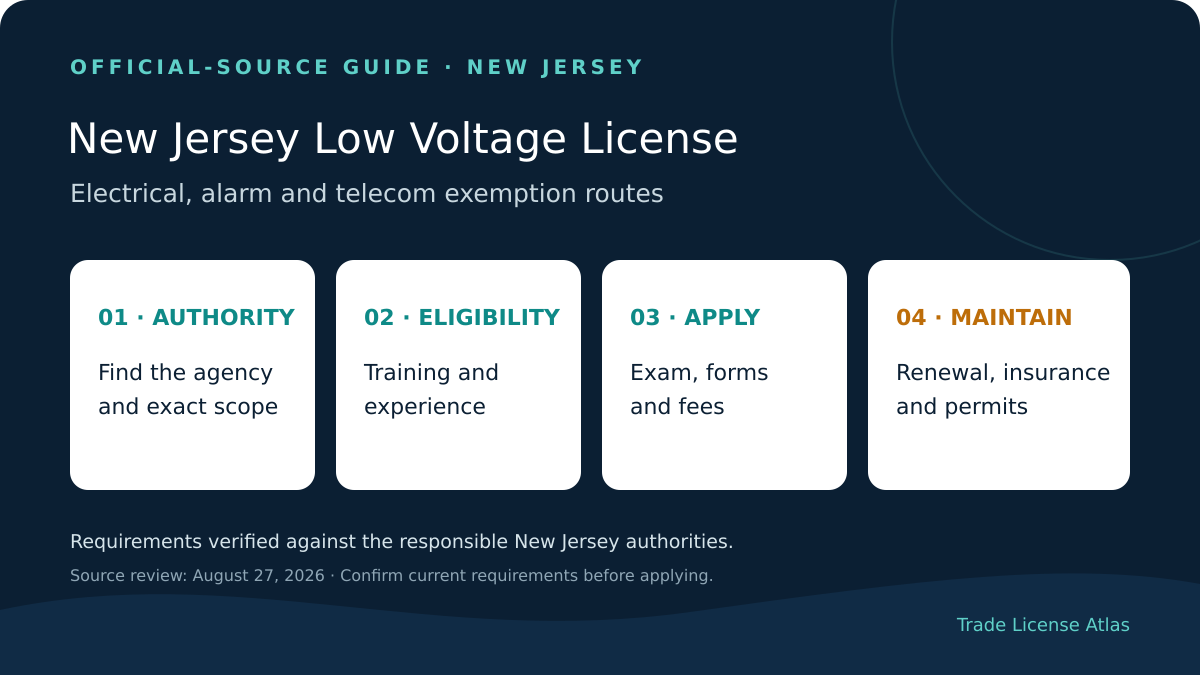
What the New Jersey low voltage license covers
New Jersey does not offer a general low-voltage electrical license. Voice and data work connected to an FCC-recognized network may qualify for a limited telecommunications wiring exemption; alarm work uses individual and business alarm licenses; other covered wiring generally requires an electrical contractor.
- Voice, data, security, alarm and other low-voltage systems only under the credential matching the exact work.
- Work only within the issued classification.
- Obtain all local permits and inspections.
Compare related occupations and states in the License Finder.
New Jersey low voltage license requirements at a glance
| Requirement | Current rule or route |
|---|---|
| Route | No universal low-voltage license; use electrical contracting, alarm licensing or a limited telecommunications wiring exemption according to scope |
| Eligibility | Depends on the route: electrical-contractor qualifications, alarm practical experience and training, or the telecommunications-exemption conditions. |
| Exam | No universal low-voltage exam; electrical and alarm examinations apply to their respective routes. |
| Fees | Credential, business, examination and permit fees depend on the scope; there is no single low-voltage-license fee. |
| Bond or insurance | Maintain insurance for the licensed or exempt business and every project requirement. |
| Renewal | Follow the triennial electrical, alarm and business cycles that apply to the work. |
Do not treat this table as an approval notice. The agency, certification organization or local jurisdiction makes the final eligibility decision and may request additional evidence.
Classify New Jersey low-voltage work by system, not voltage alone
Scope checked October 12, 2026: New Jersey electrical-contractor and alarm licensing programs, including the limited telecommunications-wiring exemption. The state does not issue one general “low-voltage license.” A low measured voltage does not by itself exempt the installer: the kind of system, work performed and the exact exemption conditions matter.
Route each job to the right credential
| Work offered | Likely route to verify | Key limit |
|---|---|---|
| Qualifying voice/data telecommunications wiring | Apply to the Board of Examiners of Electrical Contractors for the telecommunications wiring exemption; confirm the current scope and business requirements. | This is a limited exemption, not a blanket low-voltage electrician license. It can be revoked for non-exempt electrical or alarm work. |
| Burglar alarm, fire alarm or electronic security system installation, service or monitoring | Check the Fire Alarm, Burglar Alarm and Locksmith Advisory Committee route for both the individual license and licensed business. | The telecommunications exemption does not authorize alarm work. Local construction/fire permits and acceptance are separate. |
| Other wiring, controls, power supplies or electrical work outside a listed exemption | Use the electrical-contractor licensing and business-permit structure, then obtain project permits from the enforcing agency. | Do not classify work as exempt solely because it uses a small wire or low voltage. |
The electrical board identifies telecommunications exemptions among its responsibilities and publishes a specific exemption application. The alarm committee FAQ says individuals and businesses must be licensed to install, service or maintain burglar alarms, fire alarms and electronic security systems. Review the electrical rules and alarm rules for the operative limits.
Before estimating or assigning a technician
- Describe the system and every task: cable pathway, termination, device programming, alarm monitoring, power connection and any work on a panel or branch circuit.
- Identify whether the customer is buying a communications network, a protected alarm/security service or other electrical installation. Do not rely on a marketing label such as “data,” “smart home” or “low voltage.”
- Check that the person, employer and business hold the credential or exemption applicable to that exact scope. A technician’s individual credential may not satisfy the business-license requirement.
- Ask the local construction or fire official about permits, plan review, inspections and acceptance tests for the specific building and system.
- Keep the board’s written exemption/license record, permit, approved plans, test results and customer handoff documents with the job file.
Example: one contract includes ethernet cabling, card access and a fire-alarm tie-in. Those labels do not make the whole project telecommunications wiring. Separate the scopes, assign alarm work to the appropriately licensed alarm business and workers, and ask the electrical board or local official about any boundary that is not clear before work starts.
Official references: Board of Examiners of Electrical Contractors; electrical applications, including telecommunications exemption; Fire Alarm, Burglar Alarm and Locksmith FAQ; alarm applications.
Important New Jersey rules and boundaries
- The telecommunications exemption is limited to qualifying voice/data wiring.
- It does not authorize alarm or general low-voltage work.
- Alarm businesses need a licensed qualifier.
- Electrical work outside an exemption requires electrical authority.
New Jersey may separate the credential held by a worker from the contractor license held by the business, while preserving local authority over permits and inspections. Confirm every applicable layer before bidding, advertising or beginning regulated work.
New Jersey low voltage license cost and renewal
Budget separately for applications, examinations, education, insurance, business credentials and project permits.
Renew each individual and business credential separately and verify current charges before filing.
Government charges are only part of the expected cost. Training, examination preparation, fingerprints, surety premiums, insurance, equipment calibration and local permits can add to the total.
New Jersey low voltage license checklist
- Confirm that this credential matches the exact work you will perform.
- Check whether the applicant is an individual, sole owner or separate business entity.
- Collect experience and training records before submitting the application.
- Use the current official form and fee schedule.
- Complete every required examination or approved certification route.
- File bonds, insurance and fingerprints when applicable.
- Check county, city, water supplier and building-permit rules.
- Save the expiration date and renewal requirements.
Frequently asked questions
Is this credential statewide?
It depends on the occupation. New Jersey licenses several trades statewide while septic work also depends on local health-department approval.
Is an exam required?
No universal low-voltage exam; electrical and alarm examinations apply to their respective routes.
When does it renew?
Follow the triennial electrical, alarm and business cycles that apply to the work.
Are project permits separate?
Yes.
Official sources used
Selected sections reviewed October 11, 2026: New Jersey telecommunications exemption, alarm licensing and electrical-work boundaries. This is a targeted update, not a new review of every requirement.
Verified licensing details
- Jurisdiction
- state license, business registration or local permit, depending on the occupation and scope
- Licensing authority
- New Jersey Board of Examiners of Electrical Contractors and Fire Alarm, Burglar Alarm and Locksmith Advisory Committee
- Fees
- Credential, business, examination and permit fees depend on the scope; there is no single low-voltage-license fee.
- Experience
- Depends on the route: electrical-contractor qualifications, alarm practical experience and training, or the telecommunications-exemption conditions.
- Exams
- No universal low-voltage exam; electrical and alarm examinations apply to their respective routes.
- Insurance or bond
- Maintain insurance for the licensed or exempt business and every project requirement.
- Continuing education
- Maintain the continuing education attached to every electrical or alarm license held.
- Renewal period
- Follow the triennial electrical, alarm and business cycles that apply to the work.
Official sources
Original record source-check date: August 26, 2026.
Requirements can change and local rules may apply. Confirm the current requirements with the official authority before paying a fee or beginning work.