
Official-source review: August 24, 2026
California septic installer license: The specialist contractor route is CSLB’s C-42 Sanitation System classification. Depending on the complete project scope, an A General Engineering or C-36 Plumbing contractor can also have relevant authority, but every onsite wastewater project remains subject to county or local environmental-health approval.
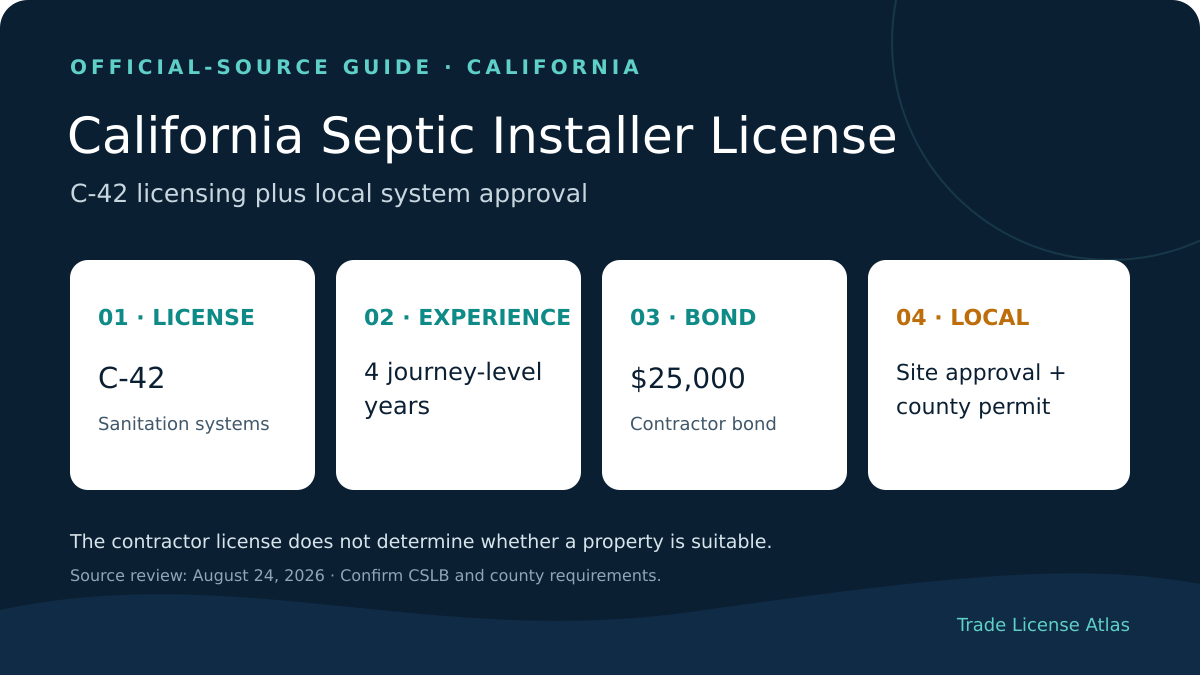
What the California septic installer license covers
The C-42 description covers septic tanks, cesspools, storm drains and related sewage-disposal structures. The project itself cannot proceed based on CSLB status alone: the local onsite-wastewater program determines feasibility and permit conditions.
- Fabrication and installation of cesspools and septic tanks.
- Storm drains and other sewage-disposal and drain structures.
- Laying approved pipe and associated hardware for sanitation systems.
- Installation within an approved local onsite-wastewater design.
- Repairs or replacement when within classification and permit scope.
Compare the overlapping piping scope in our California C-36 plumbing guide and verify the exact classification with CSLB for mixed-scope projects.
California septic installer license requirements at a glance
| Requirement | Current rule or route |
|---|---|
| Specialty classification | C-42 Sanitation System Contractor |
| Other potentially relevant classifications | A General Engineering or C-36 Plumbing, depending on scope |
| Experience | Usually four journey-level years |
| Exams | Law and Business plus C-42 |
| CSLB fees/bond | $450 + $200/$350; $25,000 bond |
| Local approval | Site-specific permit and inspections |
| Renewal | Two years for active contractor license |
Do not treat this table as an approval notice. The agency, certification organization or local jurisdiction makes the final eligibility decision and may request additional evidence.
How to complete the California septic installer license process
- Match the proposed work to C-42 or another classification with lawful scope.
- Document the qualifier’s sanitation-system experience and apply to CSLB.
- Complete fingerprints, examinations, bond and issuance requirements.
- Contact the county environmental-health or authorized local agency.
- Obtain site evaluation, design and construction approval before installation.
- Build only to the approved plans and schedule required inspections.
- Close the local permit and retain as-built and maintenance documents.
Keep copies of every experience certificate, examination result, bond or insurance filing and payment receipt. Names and business entities should match across the application and supporting documents.
Important California rules and boundaries
- The contractor license does not approve a parcel for an onsite wastewater system.
- Counties administer site evaluation, setbacks, design, permits and inspections under statewide policy and local rules.
- Alternative or advanced treatment systems can require additional design or maintenance qualifications.
- C-42 scope differs from general plumbing inside a structure.
California often separates the credential held by a worker from the contractor license held by the business. It also preserves local authority over permits and inspections. Confirm all three layers before bidding, advertising or beginning regulated work.
California septic installer license cost and renewal
Minimum CSLB application and issuance fees are $650 for a sole owner or $800 for another entity. County evaluation, design, permit and inspection costs vary substantially by property and system.
The contractor license normally renews every two years, but local septic permits and operating requirements attach to individual systems and may include inspections or maintenance beyond license renewal.
Government charges are only part of the expected cost. Training, examination preparation, fingerprints, surety premiums, insurance, equipment calibration and local permits can add to the total.
California septic installer license checklist
- Confirm that this credential matches the exact work you will perform.
- Check whether the applicant is an individual, sole owner or separate business entity.
- Collect experience and training records before submitting the application.
- Use the current official form and fee schedule.
- Complete every required examination or approved certification route.
- File bonds, insurance and fingerprints when applicable.
- Check county, city, water supplier and building-permit rules.
- Save the expiration date and renewal requirements.
Frequently asked questions
What California license installs septic systems?
C-42 is the specialist sanitation-system classification; A and C-36 contractors may also have relevant scope for some work.
Does C-42 replace the county permit?
No. Local environmental-health approval is separate and project-specific.
How much experience is required?
The usual CSLB route requires four years of journey-level or higher experience within the prior ten years.
Can every lot receive a septic permit?
No. Site conditions, setbacks, soils, water resources and local rules determine approval.
Official sources used
- CSLB C-42 classification scope
- CSLB Building Official Information Guide
- California Water Boards onsite wastewater program
- CSLB contractor application requirements
- CSLB application process
- CSLB license issuance requirements
- Official CSLB fee schedule
- CSLB workers compensation requirements
- CSLB reciprocal classifications
Verified licensing details
- Licensing authority
- California Contractors State License Board and local environmental health agency
- Fees
- $450 application plus $200/$350 issuance; local site evaluation, design, permit and inspection fees vary.
- Experience
- The C-42 qualifier usually needs four years of journey-level sanitation-system experience within ten years.
- Exams
- Law and Business and C-42 Sanitation Systems trade exams unless waived.
- Insurance or bond
- $25,000 contractor bond, possible qualifier bond and appropriate workers compensation filing.
- Continuing education
- No routine CSLB CE; local programs may require approved designers, evaluators or installers for particular systems.
- Renewal period
- Two-year active contractor renewal; local approvals are project-specific.
Official sources
Official sources last checked August 23, 2026.
Requirements can change and local rules may apply. Confirm the current requirements with the official authority before paying a fee or beginning work.